Nightmare Treatment in Austin
You don't have to keep living with the same nightmare.
Evidence-based treatment for recurring nightmares in Austin

Jessica Fink, LCSW-S, provides nightmare treatment in Austin and across Texas via online therapy.
I'm Jessica Fink, a licensed therapist specializing in behavioral sleep medicine. I treat recurring nightmares using Cognitive Behavioral Therapy for Nightmares (CBT-N), an evidence-based approach shown to reduce nightmare frequency and intensity.
You might assume nightmares are simply something you have to endure.
You hope they'll eventually go away on their own.
You try not to think about them.
You avoid talking about them.
You stay up later because you're afraid of what will happen when you fall asleep.
You are trying to fix the problem. Or at least trying to feel better. You probably figure there are no other options.
So I'm really excited to share this with you:
Nightmares are treatable.
There are evidence-based treatments that can reduce how often nightmares happen, how intense they feel, and the fear that often develops around going to bed.
Specialized Training in Behavioral Sleep Medicine
I have provided sleep-focused therapy since 2021. My training includes basic CBT-I through PESI with Colleen Carney and Meg Danforth; advanced CBT-I through the University of Pennsylvania with Michael Perlis, Donn Posner, and Jason Ellis; and CBT-N training followed by eight weeks of group consultation with Joanne Davis. I also participate in ongoing behavioral sleep medicine consultation with Donn Posner.
Professional memberships: American Academy of Sleep Medicine and Society of Behavioral Sleep Medicine
Quoted As a Sleep Expert In:
Forbes, Glamour, Reader’s Digest, Everyday Health, Tom’s Guide, and VeryWellMind.
Nightmares Don't Just Affect Sleep
People often think of nightmares as something that only affects your sleep.
In reality, nightmares can begin affecting your day as much as your night.
You may find yourself:
dreading bedtime
delaying going to sleep
feeling anxious as evening approaches
waking repeatedly during the night
struggling to fall back asleep
feeling exhausted the next day
avoiding thinking about the nightmare.
Eventually, it can feel like your entire day revolves around trying to avoid what happens at night.
Why Do Nightmares Keep Coming Back?
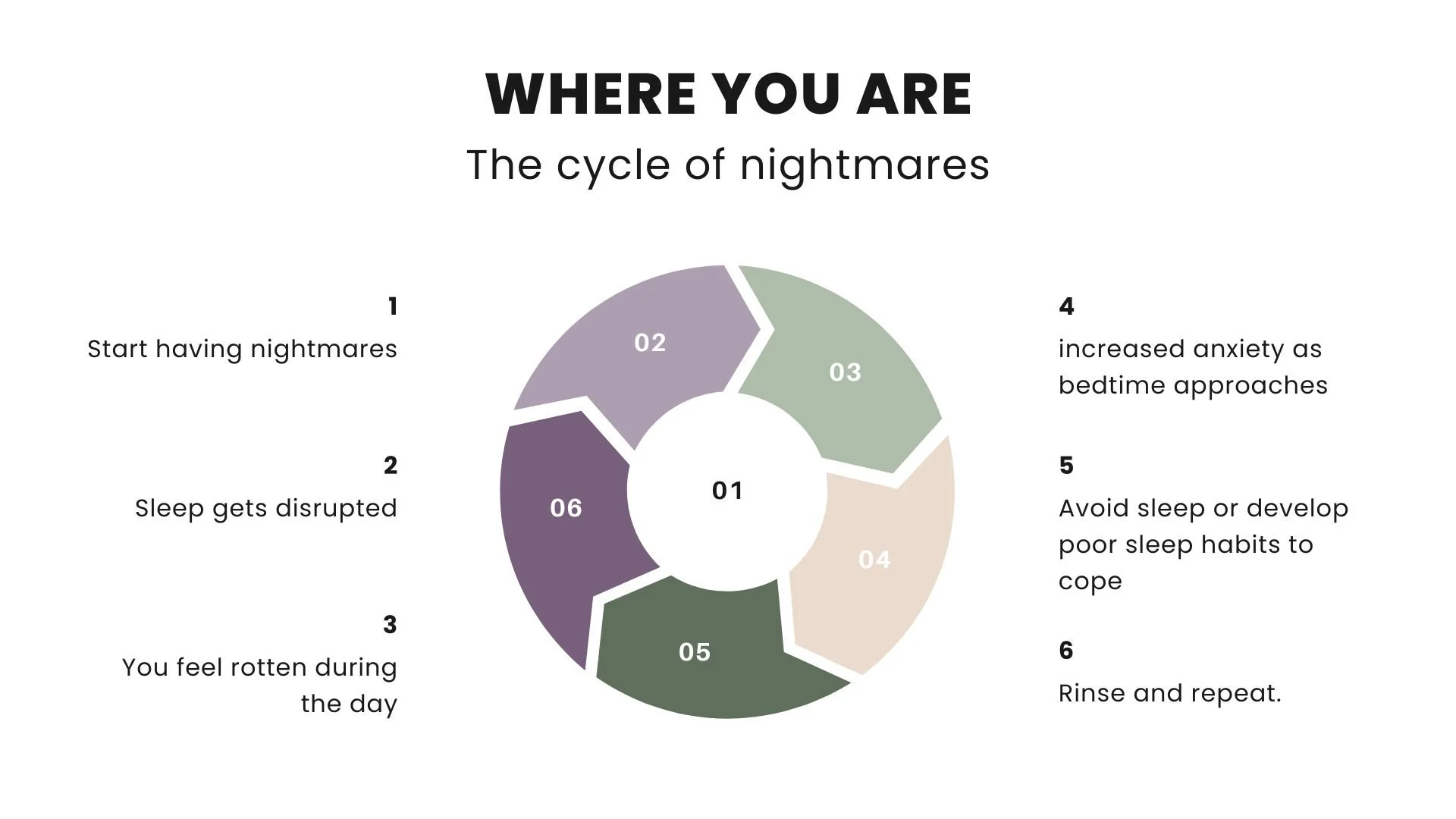
When nightmares are recurrent, people avoid reminders as much as they can.
You don't want to think about it.
You don't want to talk about it.
You certainly don't want to relive it.
Maybe you wake up suddenly, heart racing, and spend the next hour scared to go back to sleep.
Maybe you leave the TV or the lights on because that feels safer.
Maybe bedtime has slowly become something you brace yourself for instead of looking forward to.
None of those reactions are irrational.
They're exactly what most people do when something frightens them.
Unfortunately, avoidance is one of the things that can keep nightmares going.
Nightmares are a little like your brain getting stuck in a rut. Think of a record skipping or your computer getting stuck in a loop where it reboots over and over.
The nightmare becomes a well-worn path.
Further, the nightmare often wakes you before the story can resolve, so you get stuck in this endless circle of hell.
Treatment helps your brain learn a different path.
Why Treatment Happens During the Day
Even though the nightmare is happening at night, we don't do the difficult work while you're asleep. We do it while you're awake.
At night, nightmares catch you at your most vulnerable. You're asleep. You don't have your full attention, reasoning, or ability to respond.
During treatment, we're working with the nightmare during the day—when you're alert, grounded, and able to approach it intentionally rather than being overwhelmed by it.
You get to take back control.
What Is CBT-N?
I use Cognitive Behavioral Therapy for Nightmares (CBT-N), an evidence-based treatment specifically developed for recurring nightmares.
CBT-N includes imagery rehearsal (IRT) techniques while also providing a more comprehensive approach to nightmare treatment.
Treatment typically includes:
understanding how nightmares develop
learning why avoidance unintentionally keeps them going
relaxation strategies
developing healthier sleep habits
dealing with the nightmare material in a way that's been shown to take the sting out of it.
Every step has a purpose.
I'll explain why we're doing what we're doing before asking you to try it.
What Changes During Treatment?
People are frequently surprised that you can influence your dreams. They'll often say, "There's no way this could work."
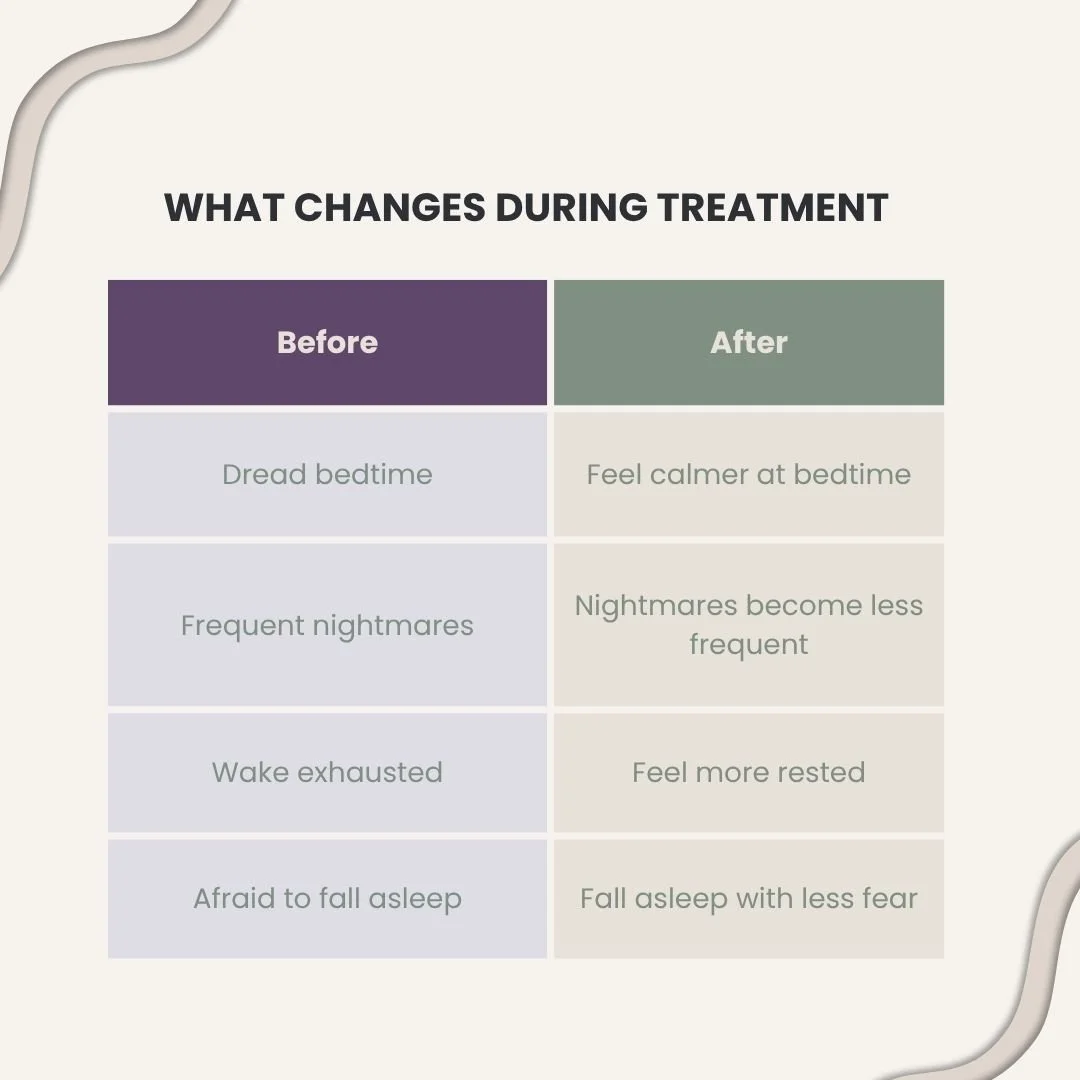
And yet, as treatment progresses, many people notice things like:
fewer nights with the old nightmare
nightmares becoming less intense
horrifying nightmares becoming silly dreams
feeling less anxious about going to bed
waking less often during the night
falling back asleep more easily after a nightmare
feeling more rested during the day.
Your brain is unlearning old habits and learning new habits.
Everything just starts feeling lighter.
Is Nightmare Treatment Right for You?
Treatment may be a good fit if:
you experience recurring nightmares
you've started dreading bedtime
you avoid thinking or talking about your nightmares
nightmares are affecting your sleep or daily life
you're looking for an evidence-based treatment rather than simply hoping they'll improve on their own.
What to Expect When You Start Nightmare Treatment
Before scheduling, we’ll have a brief consultation call. I’ll ask a few general questions to determine whether what you’re experiencing sounds like recurring nightmares, explain how CBT-N works, and review the six-session treatment structure.
Your first paid appointment is an assessment. We’ll look at how often the nightmares occur, how they affect your sleep and daytime life, and whether concerns such as insomnia, medications, sleep apnea, or another sleep disorder may also be involved. I may ask whether the nightmares are connected to a broad category of trauma, but you will not be asked to describe the traumatic experience in detail. We’re targeting the nightmare, not the trauma.
Active treatment begins at the following session. We start with education, sleep habits, grounding strategies, and tracking your sleep and nightmares. Later, when we work directly with a nightmare, you’ll write it down and read it aloud once. Then we’ll develop a new version and repeatedly practice imagining the new dream, not the nightmare.
You Don't Have to Keep Dreading Bedtime
If you've been living with recurring nightmares, you've probably spent a long time trying to avoid them. That makes sense. Avoidance is a natural response to something frightening.
The encouraging news is that your brain is capable of learning a new path to take at night.
The first step isn't forcing yourself to "get over it." It's understanding why the nightmares keep returning—and learning how to help your brain choose a different way to go.
Frequently asked questions about nightmare treatment in Austin
-
If you have repeated and intense nightmares, you might have nightmare disorder. You may or may not have a trauma history (some do and some don’t). Whatever the cause, if nightmares are causing you to avoid sleep or impacting your day, CBT for Nightmares is a good option.
-
No. Nightmares can develop after trauma, but they can also occur without a trauma history or without any identifiable connection to a traumatic event. They may occur alongside sleep disorders such as narcolepsy, be associated with certain medications or substances, or arise for no obvious reason.
I treat both standalone nightmare disorder and trauma-related nightmares. CBT-N targets the nightmare and the sleep patterns surrounding it; you will not be asked to describe or retell a traumatic experience in detail.
-
Nightmare disorder involves recurring, well-remembered nightmares that cause significant distress, disrupt sleep, or affect daytime functioning. These nightmares can occur without a history of trauma.
PTSD-related nightmares occur in the context of other post-traumatic stress symptoms and may replay a traumatic event or contain themes and emotions connected to it. However, having trauma-related nightmares does not automatically mean someone meets the full criteria for PTSD. Nightmare disorder can also be diagnosed alongside PTSD when the nightmares need treatment in their own right.
I treat both standalone nightmare disorder and recurring nightmares related to trauma.
-
Of course! I was trained to think of nightmares as a learned habit in the brain. Your thoughts go down the same path every night because that’s what they always do. There is something about engaging with the nightmare during the day and on your terms that allows your brain to go down a different path and you to finally get some peace!
-
CBT-N is an evidence-based treatment for recurring nightmares. It combines education about nightmares and sleep, relaxation strategies, healthier sleep habits, and techniques drawn from Imagery Rehearsal Therapy and Exposure, Relaxation, and Rescripting Therapy. A central part of treatment is developing and rehearsing a different version of the nightmare while you’re awake, which helps your brain practice a new path rather than repeatedly returning to the same distressing dream. The American Academy of Sleep Medicine recommends Imagery Rehearsal Therapy for both nightmare disorder and PTSD-associated nightmares.
-
The curriculum is 6 sessions plus an intake session so anticipate 7 sessions total. It depends on how many nightmares we target.
-
Why wouldn’t you? Most people find peace when they sleep; you find terror. A nightmare comes at you when you are at your most vulnerable, and you feel completely defenseless. The good news is that you aren’t. We can tackle the nightmare head-on, and then you are no longer at its mercy.