If you can't fall asleep until 2 or 3 AM, the solution seems pretty obvious. Go to bed earlier. Maybe stop drinking caffeine. Put your phone away. Buy some blackout curtains. Start a relaxing bedtime routine. And if none of that works, try harder.
Except you've probably already tried all of that. And you're still lying awake at midnight, wondering why your brain apparently didn't get the memo that it's bedtime. Here's the problem: Going to bed earlier doesn't, by itself, induce sleepiness.
Your circadian rhythm doesn't change based on desire. But that doesn't mean you're stuck with your current sleep schedule forever. You can influence the timing of your body clock. You just have to understand what actually makes it move. And trying harder ain’t it.
First, What Exactly Is Your Circadian Rhythm?
Your circadian rhythm is an internal biological timing system that helps regulate when you feel alert and when you feel sleepy. It's not simply a habit or a preference. It's a physiological process. Your brain has a central clock, located in a part of the hypothalamus called the suprachiasmatic nucleus. This clock helps coordinate rhythms throughout your body, including body temperature, hormone release, and the timing of sleep and wakefulness.
Your circadian rhythm runs on a cycle that's approximately 24 hours long. But it isn't perfectly synchronized to the 24-hour day all by itself. It needs regular signals from the environment to stay aligned. The most powerful of those signals is light.
If your internal clock is running later than the schedule you need to maintain, you may have what's called delayed sleep-wake phase disorder, or delayed sleep phase. That means your brain is promoting sleep and wakefulness at times that don't match your responsibilities.
For a broader explanation of how these biological rhythms work, I've written about circadian rhythms and their disorders.
Why Going to Bed Earlier Doesn't Work
Let's say your body naturally wants to sleep from 3 AM until 11 AM. But you need to wake up at 7 AM. So you decide to start going to bed at 11 PM. That sounds reasonable. You need more sleep, so you should give yourself more time in bed.
Except your body clock is still operating on a 3 AM to 11 AM schedule. At 11 PM, your brain may still be actively promoting wakefulness. You're essentially asking your body to fall asleep four hours before its biological night begins. That's a little like asking someone with a conventional sleep schedule to go to bed at 7 PM.
They can get into bed. They can turn off the lights. They can close their eyes. But none of those things necessarily means they're going to fall asleep. You can change what time you get into bed without changing what time your brain is ready for sleep.
And if you spend enough nights lying awake, frustrated, and trying to make sleep happen, you may eventually develop insomnia on top of the circadian timing problem. Which is a fun little bonus nobody asked for.
Sleep Pressure and Your Body Clock Are Two Different Things
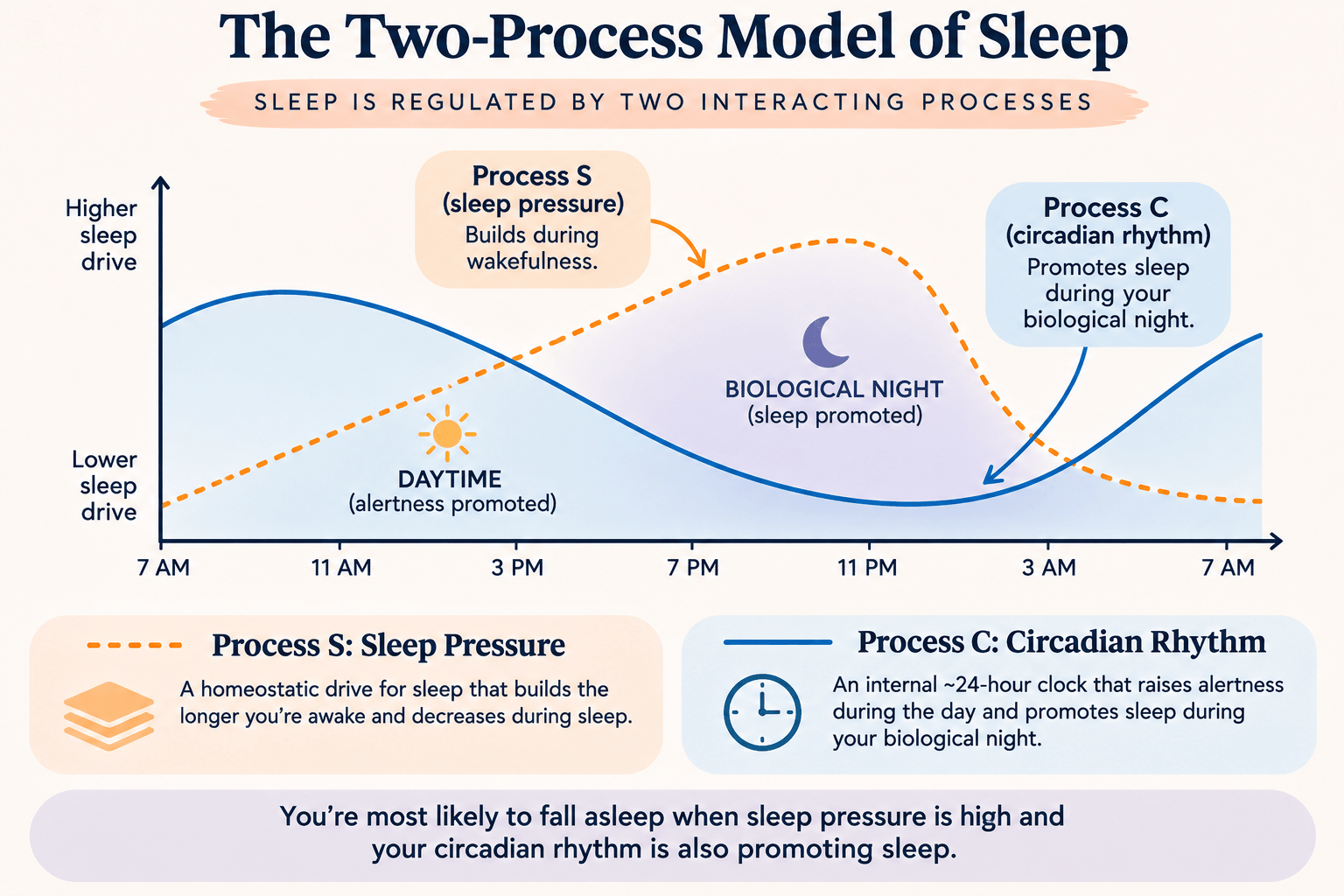
Sleep is regulated by two interacting processes: sleep pressure, which builds the longer you're awake, and your circadian rhythm, which influences when your brain promotes alertness or sleep. You can be exhausted from a lack of sleep but still struggle to fall asleep if your body clock is promoting wakefulness. This helps explain why people with delayed sleep phase can't simply go to bed earlier and expect to fall asleep.
Your sleep is regulated by two interacting processes. The first is sleep pressure, sometimes called Process S. Sleep pressure builds the longer you've been awake. Think of it like hunger. The longer you go without sleeping, the greater your need for sleep becomes. When you sleep, that pressure decreases.
The second is your circadian rhythm, sometimes called Process C. Your circadian system influences when your brain promotes alertness and when it promotes sleep. These processes work together, but they aren't the same thing.
How Can You Be Exhausted but Not Sleepy?
Someone with delayed sleep phase may have to wake up at 7 AM for work, even though their body didn't want to fall asleep until 3 AM. By 10 PM, they're exhausted. They've been functioning on four hours of sleep. Their sleep pressure is high. So they get into bed. And they can't sleep. Why? Because their circadian system is still sending a wakefulness signal.
Being exhausted doesn't automatically mean your body is biologically ready for sleep. This is why I distinguish between being tired and being sleepy. Tired means you're fatigued, worn out, or low on energy. Sleepy means you're actually experiencing the physiological drive to fall asleep. You can be tired without being sleepy. And when someone has a delayed circadian rhythm, the difference can be particularly frustrating.
Light Is the Most Powerful Tool for Shifting Your Circadian Rhythm
Your brain uses light to help determine what time of day it is. Specialized cells in your eyes detect light and send information to your brain's central clock. That information helps synchronize your internal rhythm with the outside world. But here's the part most people don't know: Light doesn't have the same effect on your circadian rhythm at every time of day. Depending on when you're exposed to it, light can shift your body clock earlier or later.
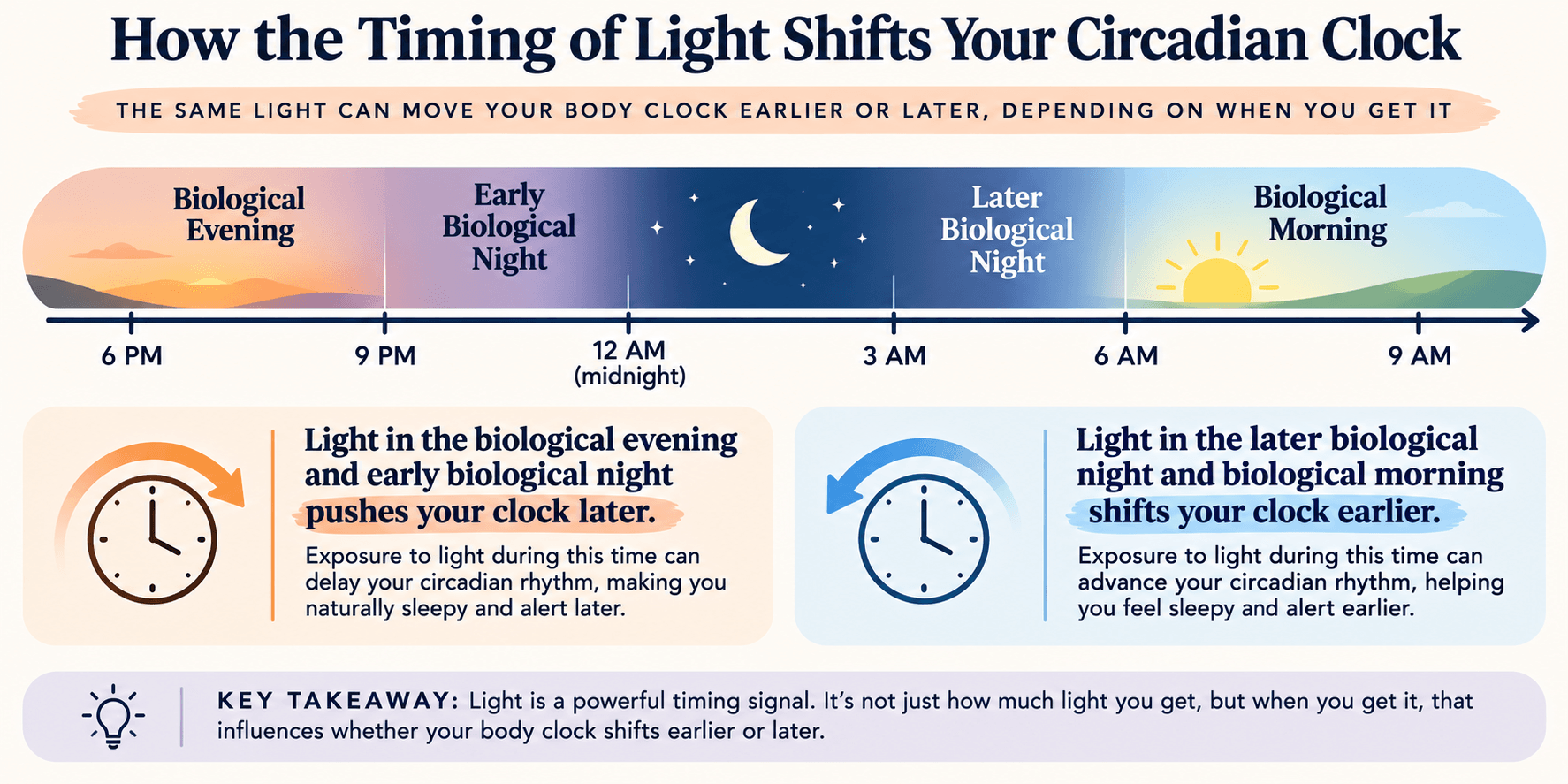
Light is one of the most powerful signals regulating your circadian rhythm, but timing matters. Light exposure during your biological evening can push your body clock later, while appropriately timed light during your biological morning can help shift it earlier. The times shown are illustrative—your biological morning and evening depend on your individual circadian rhythm, not simply the time on the clock.
Light Can Move Your Clock in Either Direction
Light exposure during the biological evening and early biological night tends to push your circadian rhythm later. Light exposure during the later biological night and biological morning tends to shift it earlier. This is why simply telling someone to get more sunlight isn't a complete treatment recommendation. We need to know when they're getting that light relative to their internal clock.
For someone with a significantly delayed rhythm, their biological morning may occur much later than the conventional clock time we call morning. So, if you expose someone to bright light too early in the morning, you can actually shift their rhythm in the opposite direction from what you're trying to accomplish.
Why Morning Light Matters
When appropriately timed, morning light can help advance a delayed circadian rhythm. That means it can help your body begin promoting sleep and wakefulness earlier. Light exposure can come from natural daylight or, in some circumstances, a therapeutic light device. But timing, intensity, and duration all matter. This is one reason I don't recommend that people with suspected circadian rhythm disorders simply buy a light box and start using it whenever they wake up. We need to understand their current sleep timing first.
What About Blue Light and Blue-Blocking Glasses?
You've probably heard that blue light is bad for sleep. That's an oversimplification. Depending on the sleep issue, blue light is highly relevant or not something I worry about. Short-wavelength light, which includes blue light, is particularly effective at signaling to your circadian system that it's daytime. That can be useful when you're trying to shift your body clock earlier.
But exposure to that same light during your biological evening can work against you. This is where evening light management comes in. For some people, I recommend blue-blocking glasses at strategically selected times to reduce the circadian impact of evening light exposure.
The goal isn't to rid your life of screens if you don’t want to. It's to control the timing of the light signals your brain receives. And just as with morning light exposure, the timing of the glasses matters. Sometimes you want blue light, and sometimes you don’t.
Melatonin Isn't Just a Sleeping Pill
Melatonin may be one of the most misunderstood tools in sleep treatment. People often take it right before bed because they think it's supposed to knock them out. The instructions on the bottle even say “take at bedtime”! But melatonin is not a hypnotic; it’s a chronobiotic.
In other words, melatonin is a hormone involved in signaling biological night, not a drug that induces sleep. The timing of your sleep onset is influenced by the timing of your brain’s melatonin production. And when we're treating delayed sleep phase, we can sometimes use appropriately timed melatonin to help shift the circadian rhythm earlier.
With Melatonin, Timing Is the Treatment
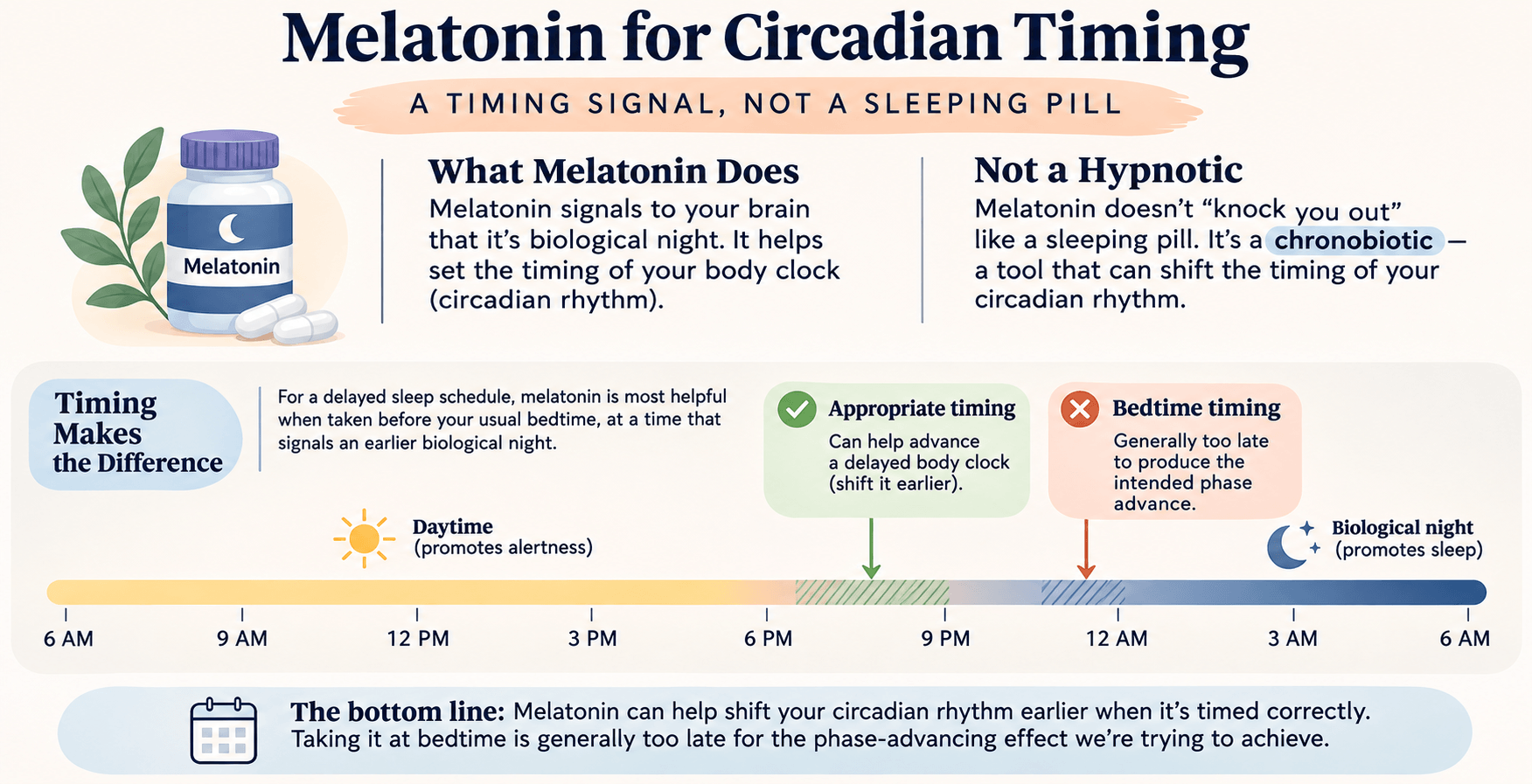
Melatonin is a chronobiotic, meaning it helps influence the timing of your biological clock rather than simply putting you to sleep. When treating delayed sleep phase, taking melatonin at the appropriate time can help shift your circadian rhythm earlier. Taking it right at bedtime is generally too late to achieve the desired phase advance. The ideal timing depends on your individual circadian rhythm, which is why melatonin timing should be tailored to your sleep schedule rather than based on the instructions on the bottle.
Melatonin has different effects depending on when you take it relative to your biological clock. Taking it at bedtime will not shift your sleep timing. That’s probably too late. The dose matters, too, but taking the right amount at the wrong time can still miss the intended circadian effect.
This is why I spend so much time talking to clients about melatonin timing. The goal isn't to knock you out. We're trying to advance when your body begins its biological night over time. That requires a different approach than grabbing a bottle of melatonin gummies and taking a couple right at bedtime.
I don't recommend guessing at a dose or timing schedule based on a generic online protocol. Individual sleep timing, medical considerations, and the intended direction of the shift all matter.
Why a Consistent Sleep Schedule Matters So Much
A lot of people with delayed sleep phase have erratic schedules. This can be especially true for people who aren't currently working or attending school. Without an external reason to get up at a particular time, bedtime and wake time can move around quite a bit.
Maybe you fall asleep at 2 AM one night, 4 AM the next, and 5:30 AM the night after that. Then you sleep until noon, or 2 PM, or whenever you wake up.
In the sleep world, we call this social jet lag. Just like with travel jet lag, your brain is no longer anchored to what time it is, and the schedule keeps changing, which means less predictability in sleep and wake times.
And when we're trying to shift a circadian rhythm, we’ve got to get your schedule consistent first.
Why We Don't Start by Forcing an Early Bedtime
One of the first things I do in treatment is figure out what someone's sleep schedule actually looks like. Not what they think it should look like. Not what their parents or employer wish it looked like. What their body is currently doing.
Then we use that information to establish a consistent starting point. There's no point telling someone whose body wants to sleep at 3 AM that they should immediately start going to bed at 10 PM. We've already established how well that tends to work.
How I Help Clients Shift Their Circadian Rhythm
When I'm working with someone who has delayed sleep phase, I don't start by handing them a list of sleep hygiene rules. We start by collecting information.
Step 1: Track Sleep for at Least Two Weeks
I have clients complete a sleep diary for at least two weeks. During this period, I want them to follow their natural sleep schedule as much as their responsibilities allow. This is sometimes called an ad lib sleep schedule.
Essentially, we're trying to observe what happens when they're not constantly forcing their sleep into a schedule that doesn't fit. I use the sleep diary to calculate their average bedtime and wake time. That gives us a starting point based on actual sleep patterns rather than wishful thinking.
Step 2: Establish a Consistent Starting Schedule
Once we have those averages, I ask clients to follow that schedule consistently for at least four days. We aren't shifting it earlier yet. We're establishing a stable pattern. During this period, I also provide individualized guidance about the timing of melatonin, evening blue-blocking glasses, and morning light exposure. These interventions work together to provide consistent timing signals to the circadian system.
Step 3: Shift the Schedule Earlier in 30-Minute Increments
Once we've established a consistent schedule, we begin moving it earlier. We shift bedtime and wake time by 30 minutes at a time. And importantly, we adjust the timing of the light exposure, blue-blocking glasses, and melatonin along with the sleep schedule. We’re using the signals your brain responds to, nudging your body clock in the direction we want to go.
Step 4: Continue Until We Reach the Target Schedule
We keep going until we get to your goal bedtime and wake time. The target depends on your life’s demands. For some people, that might mean sleeping from midnight to 8 AM. For others, it might mean 11 PM to 7 AM. And for some, it may make more sense to accommodate a naturally later schedule rather than trying to shift it.
The goal isn't to turn everyone into a morning person. The goal is to find a sustainable schedule that works. This is a description of how I approach treatment, not a universal do-it-yourself protocol. The timing of these interventions needs to be individualized.
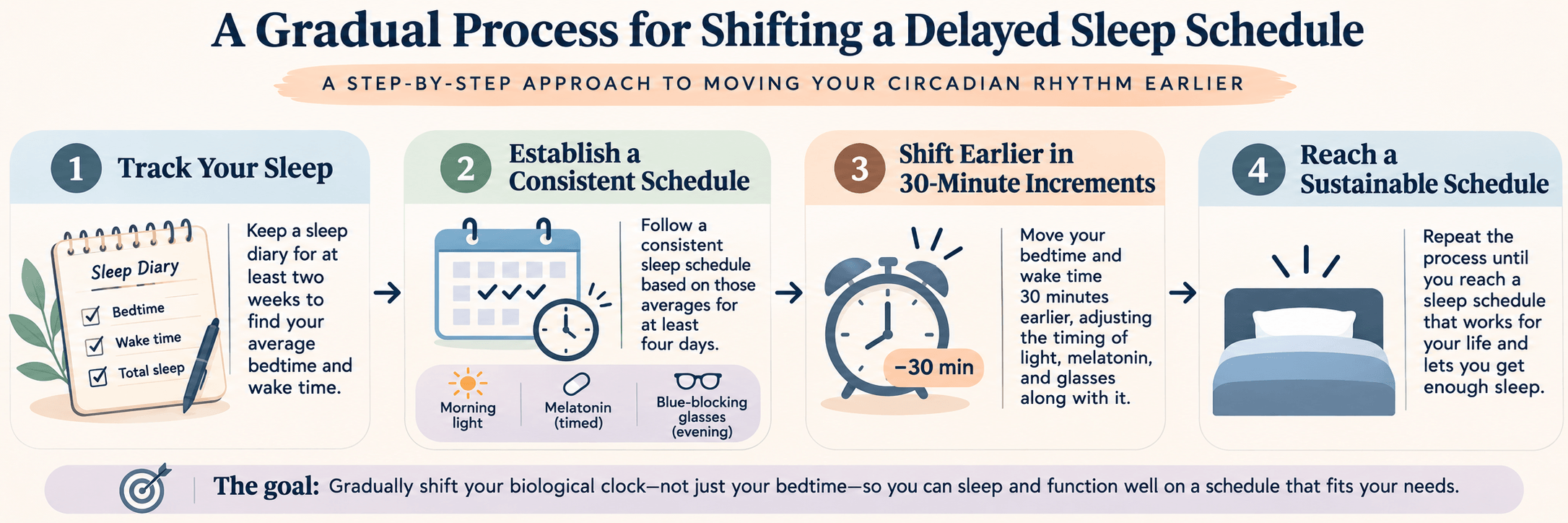
Shifting a delayed circadian rhythm takes more than going to bed earlier. Treatment begins with at least two weeks of sleep tracking to identify your natural sleep patterns, followed by establishing a consistent schedule. From there, we gradually move bedtime and wake time earlier in 30-minute increments, adjusting the timing of morning light, evening blue-blocking glasses, and melatonin along the way. The goal is to shift your biological clock gradually until you reach a sustainable sleep schedule that works for your life.
What If You Also Have Insomnia?
Sometimes someone has delayed sleep phase and insomnia. This happens when they develop conditioned arousal around bedtime after months or years of unsuccessfully trying to force sleep. Now their body clock is delayed, and their brain has learned to associate bed with being awake. In those cases, I generally treat the insomnia first using cognitive behavioral therapy for insomnia, or CBT-I.
Why? Because shifting someone's circadian rhythm doesn't necessarily undo conditioned arousal. If their brain has learned to associate bed with wakefulness, moving their biological clock earlier may not be enough to help them fall asleep.
I explain this distinction in more detail in my article, Delayed Sleep Phase vs. Insomnia: They Aren't the Same Sleep Problem.
Do You Actually Need to Change Your Circadian Rhythm?
Here's something I want to emphasize. Having a late chronotype isn't automatically a disorder. Some people are naturally night owls. If you can follow a later schedule, get enough sleep, and function well, there may be no reason to change it.
Maybe you work evenings. Maybe you have a flexible job. Maybe you've deliberately built your life around the hours when you feel your best. That's perfectly reasonable.
We start considering treatment when your sleep timing causes significant distress or interferes with your ability to function. And even then, changing your schedule or responsibilities may sometimes be a better option than changing your body clock.
There is nothing inherently virtuous about waking up at 5 AM.
Can You Change Your Circadian Rhythm? Yes, but You Have to Work With Your Biology
Your circadian rhythm isn't completely fixed. It responds to environmental signals, and we can use those signals to gradually shift its timing. But the process requires more than an earlier bedtime, a good sleep hygiene routine, or ill-timed melatonin.
We need to understand where your body clock currently is, establish a consistent schedule, and coordinate the timing of light exposure, melatonin, and other behavioral interventions.
You can't simply decide to be sleepy four hours earlier tonight. But you may be able to gradually shift the biological processes that determine when sleep happens. That's a much more useful goal than lying in bed at 10 PM, trying to convince your brain that it's midnight.
Circadian Rhythm Treatment in Austin
If your sleep schedule is consistently later than you want or need it to be, and attempts to go to bed earlier haven't worked, it may be worth evaluating whether your circadian rhythm is contributing to the problem.
I provide delayed sleep phase treatment in Austin for adults who struggle to align their biological sleep timing with their daily responsibilities.
Treatment starts with understanding your actual sleep patterns. From there, we can determine whether shifting your circadian rhythm makes sense, whether insomnia also needs attention, and what approach best fits your circumstances.
Because getting into bed earlier isn't the same thing as being ready to sleep earlier.
About the Author
Jessica Fink is a therapist in Austin, Texas, who specializes in treating insomnia and circadian rhythm sleep-wake disorders in adults. She uses evidence-based behavioral treatments, including cognitive behavioral therapy for insomnia (CBT-I), to help people understand what's interfering with their sleep and address the underlying problem.
Her approach recognizes that not every sleep problem is insomnia, and not everyone needs to become a morning person to sleep well.
Learn more about Jessica Fink and her practice.