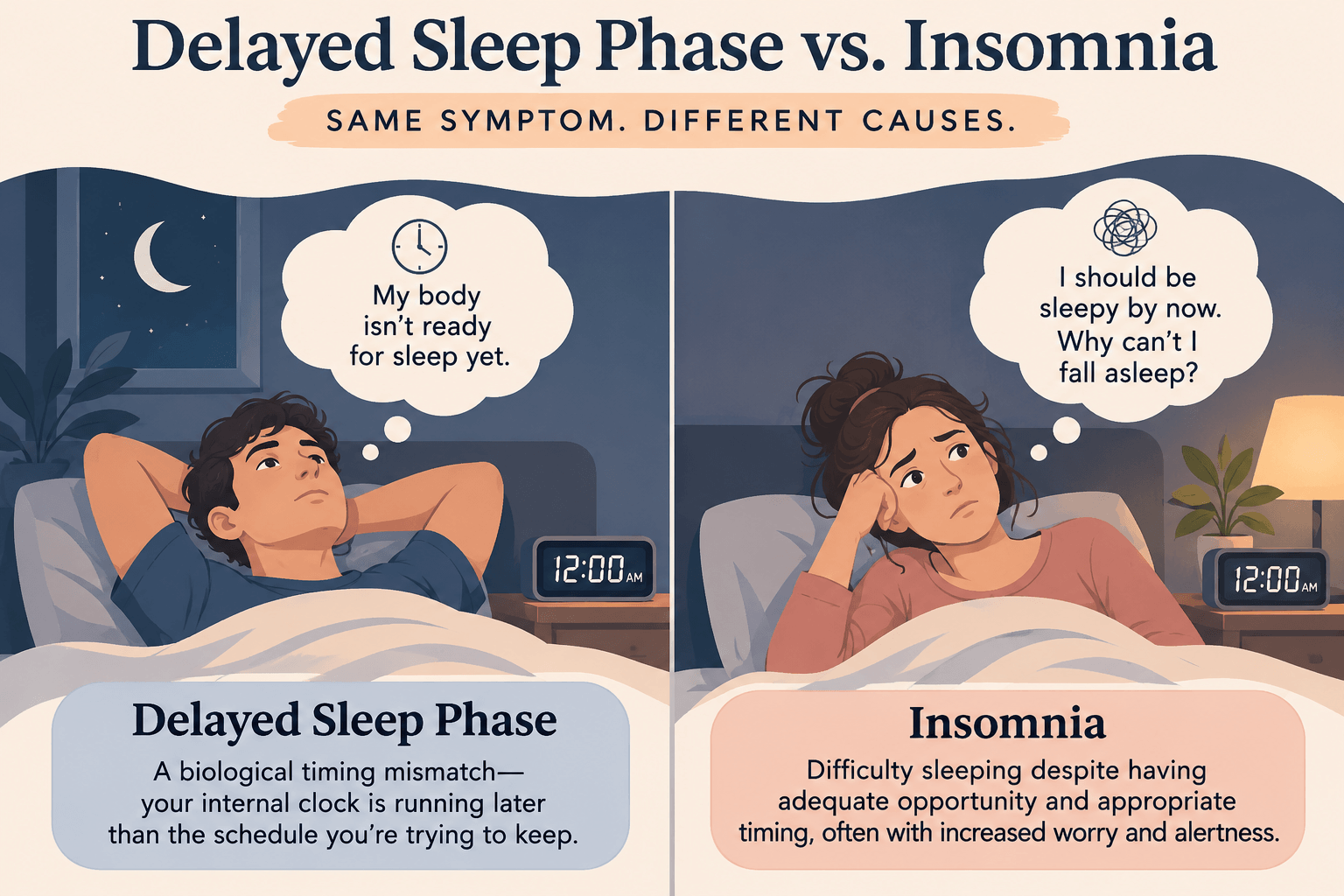
Delayed sleep phase and insomnia can look similar, but they have different underlying causes. With delayed sleep phase, your internal clock isn't ready for sleep at the time you're trying to go to bed. With insomnia, difficulty sleeping may persist even when your body is biologically ready for sleep. Understanding the difference is essential because the treatments aren't the same.
You're exhausted. You get into bed at 10 PM because you have to be up at 6 AM. Seems like the reasonable thing to do. But 11 PM comes and goes. Then midnight. Then 1 AM. And you're still awake.
So what's wrong? It’s insomnia, right? Maybe and maybe not. Let me explain.
Insomnia can be hard to distinguish from something I’ll call Delayed Sleep Phase (the official diagnosis name is ridiculously long, so we’re going with Delayed Sleep Phase). In both cases, someone may take forever to fall asleep, struggle to get out of bed in the morning, and feel exhausted during the day.
But they do not have the same cause. And treating one as though it's the other is likely to be ineffective. To figure out what's going on, we need to look beyond how long it takes you to fall asleep. We need to understand what’s keeping you awake.
What Is Insomnia?
Insomnia is difficulty falling asleep, staying asleep, or waking earlier than intended, despite having an adequate opportunity to sleep. It also causes distress and/or problems with daytime functioning. Someone with insomnia might be physically exhausted, have plenty of time available for sleep, and still struggle to sleep.
There are a number of factors that can contribute to insomnia, but one of the most important is conditioned arousal. This is when your brain learns to associate your bed, bedroom, or bedtime with being awake rather than being asleep. How does that happen? Usually through repetition.
You get into bed and can't sleep. You start thinking about tomorrow. You check the clock. You calculate how many hours of sleep you can still get. You worry about how terrible you're going to feel at work. And then you do it again the next night. Eventually, getting into bed itself can become a cue for wakefulness.
You've essentially trained your brain to be alert in the very place where you're trying to sleep. Which is obviously not ideal.
When Trying Harder to Sleep Makes Things Worse
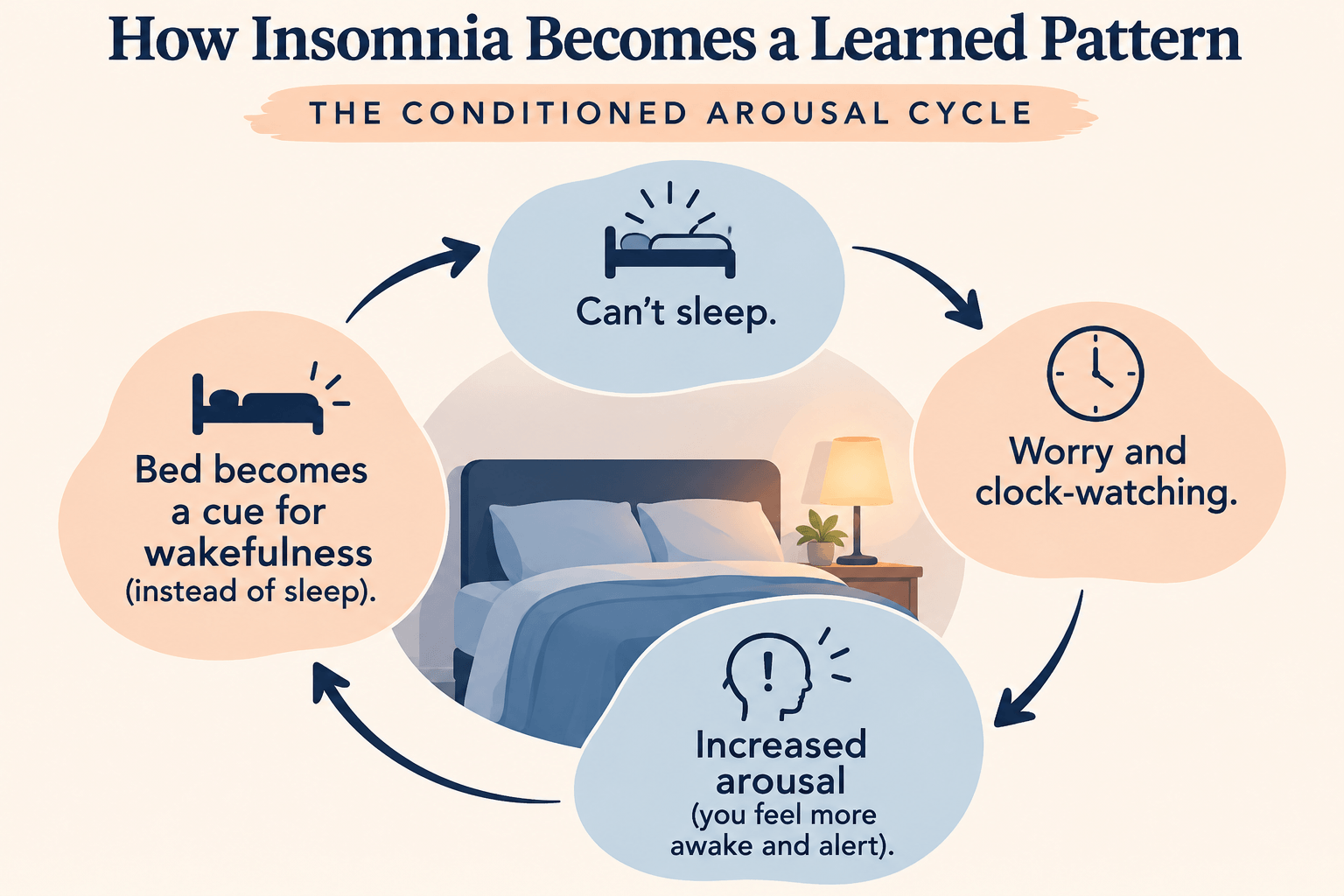
Insomnia can become a learned pattern. When you repeatedly lie awake worrying about sleep, your brain can begin associating your bed with frustration and alertness rather than sleep. This is called conditioned arousal, and it's one of the main problems CBT-I is designed to address.
Sleep is weird, and it doesn’t respond to effort. Or maybe more accurately, it responds negatively to effort. Sleep is not really a thing you do. It’s a thing that happens naturally when you don’t do. Often, doing that interferes with sleep.
People with insomnia think about sleep all the time. They usually find themselves doing more and more and more and sleeping worse and worse and worse. Ask a good sleeper in your life what they do to sleep, and the answer is almost always “nothing.” Meanwhile, for the person with insomnia, their bed has become the place where they do all this striving.
That's why insomnia treatment targets the sleep effort directly rather than just teaching relaxation exercises or giving a sleep hygiene list. Relaxation and sleep hygiene have usually become sleep effort by the time someone gets to me anyway.
What Is Delayed Sleep Phase Disorder?
Delayed sleep-wake phase disorder, or DSWPD, is a circadian rhythm sleep-wake disorder that has a different cause than insomnia. Your circadian rhythm is the internal biological system that helps regulate when you feel alert and when you feel sleepy. In someone with delayed sleep phase, that system is running later than the schedule they're trying to maintain.
For example, your body might naturally want to sleep from 3 AM until 11 AM. But you have to be at work at 8 AM. You try to go to bed at 10 or 11 PM because that's what a responsible adult is “supposed” to do. Except your brain isn't ready to sleep. It may be 10 PM according to the clock on your nightstand, but your biological night hasn’t started.
For someone whose circadian rhythm is significantly delayed, trying to fall asleep at 10 PM can be a lot like asking someone with conventional sleep timing to fall asleep at 7 PM. Ain't no way they're falling asleep. Their body clock isn't there yet.
The Problem Is Sleep Timing Rather Than the Ability to Sleep
Here's how we distinguish insomnia from delayed sleep phase. Someone with delayed sleep phase will usually sleep well if they can sleep on their body’s preferred schedule. They might struggle for hours to fall asleep at 11 PM, but fall asleep quickly at 3 AM. If they can sleep until 11 AM, they may get a full night's sleep and wake up feeling reasonably rested. They have the ability to sleep. Just not at times that align with the demands of their life.
Now, I want to clarify that having a late chronotype isn't a disorder in itself. If you naturally sleep from 3 AM to 11 AM, get enough sleep, function well, and aren't distressed by your schedule, you may not need treatment. Some people seek employment that lets them work a later schedule, and that is a 100% valid choice.
But let’s say your life demands a more conventional schedule and you are suffering because you can't get your body to follow that schedule no matter how hard you try; now we’re knocking on disorder territory.
For a broader explanation of how these internal clocks work, see my article on circadian rhythms and their disorders.
Delayed Sleep Phase vs. Insomnia: What's the Difference?
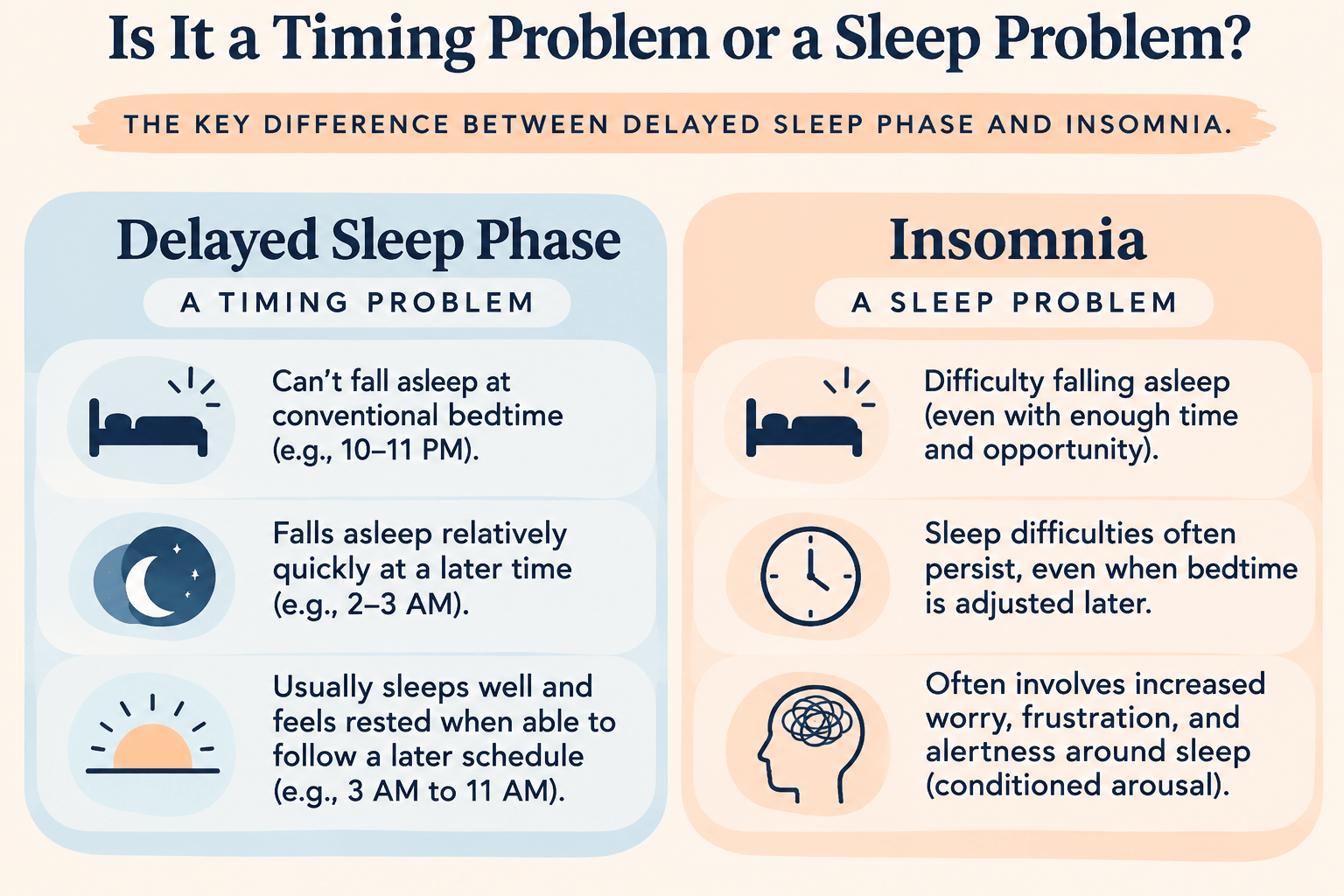
Delayed sleep phase and insomnia can both make it difficult to fall asleep, but for different reasons. With delayed sleep phase, your body clock runs later than the schedule you're trying to follow, so you may sleep perfectly well at a later bedtime. With insomnia, difficulty sleeping can persist even when you adjust your schedule. Understanding which problem you're dealing with is the first step toward choosing an effective treatment.
Let's imagine two people who both take a long time to fall asleep.
The first person gets into bed at 10 PM and lies awake for four hours. But once they fall asleep at 2 AM, they’re sleeping pretty well. They could easily sleep longer than the time they have to get up for work. Further, when they're off work, they naturally start going to bed at 2 AM. They fall asleep within 15 minutes, sleep through the night, and wake up around 10 AM feeling fine.
The second person also takes several hours to fall asleep. But simply going to bed later doesn’t fix the problem. Whenever they get into bed, no matter what time it is, they are met with frustration and worry.
The first person's pattern looks more circadian. The second person's pattern looks more like insomnia.
Of course, real people aren't always that easy to sort into clear categories. But what happens (or doesn’t) when someone follows their preferred sleep schedule is a useful clue.
Can You Have Both Insomnia and Delayed Sleep Phase?
Yep. It usually starts with just the phase delay. You’re unable to fall asleep at a time that allows you to get enough sleep to function well during the day. Eventually it starts creating problems in your life. You oversleep, you’re late to work, you are not at your best during the day. Until nighttime, when you somehow come alive during the time you need to be winding down.
So you start stressing about your sleep. Pushing harder to make yourself sleep when you get into bed. Now as soon as you get into bed, you’re agitated. Even if you were feeling sleepy on the couch.
Congratulations. Now you’ve got insomnia in addition to the phase delay. I see it all the time.
Why We Have to Treat Both Issues
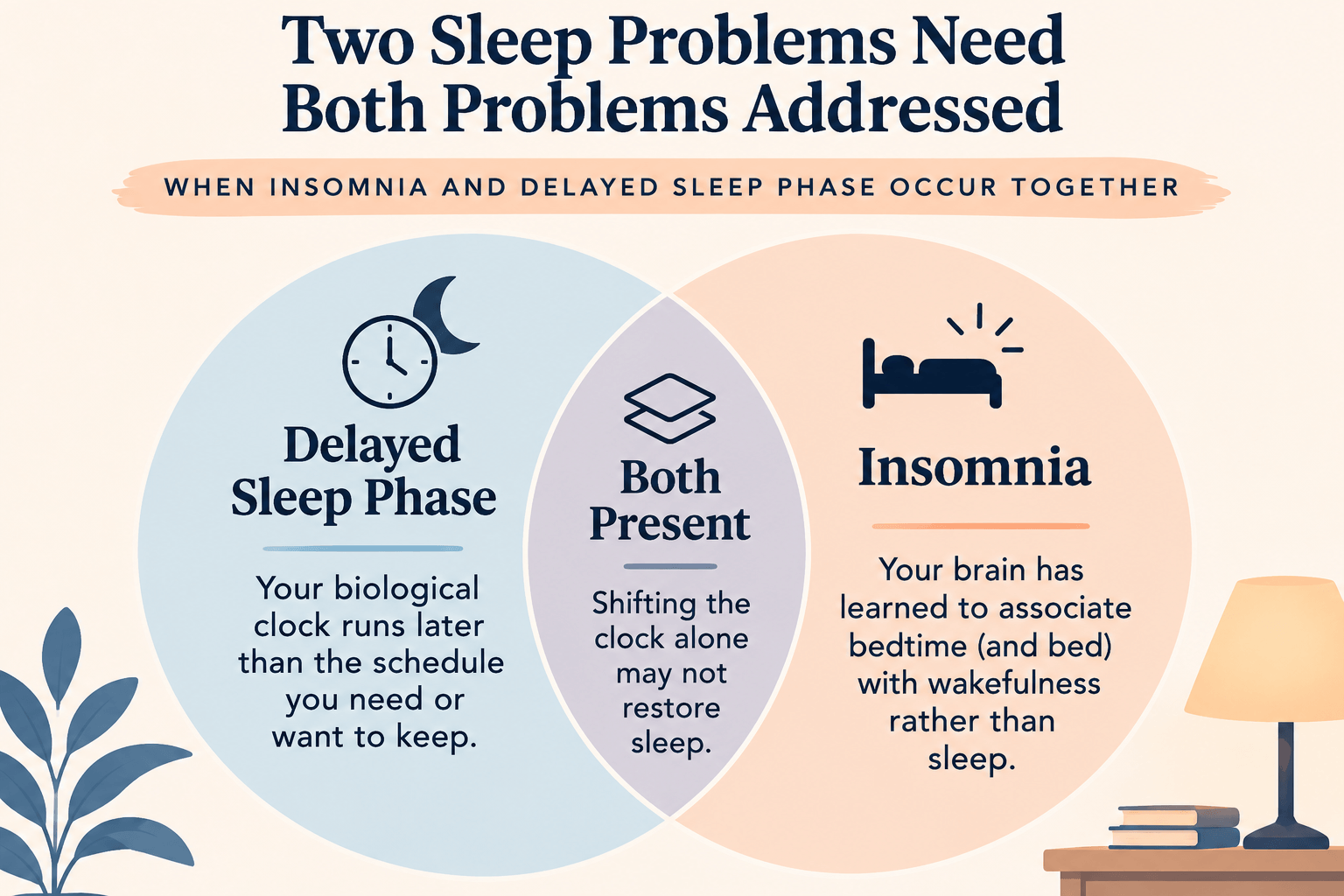
Delayed sleep phase and insomnia are different sleep disorders, but you can have both. A delayed body clock can make it difficult to fall asleep at conventional times, while conditioned arousal can make it difficult to sleep even when your body is biologically ready. When both are present, treatment needs to address both the circadian timing problem and the learned association between bed and wakefulness.
Let's say we identify your delayed circadian rhythm and successfully begin shifting it earlier. Your brain starts becoming biologically ready for sleep at midnight instead of 2 AM. Great.
Except you've spent months or years associating bedtime with being awake and frustrated. That conditioned arousal doesn't necessarily disappear just because your circadian rhythm has shifted. Your biological clock may now be ready for sleep, but your brain has also learned to associate bed with wakefulness. And that wakefulness can override your sleep drive even if we get the timing right.
Shifting your sleep timing doesn’t address the conditioned arousal that characterizes insomnia. If you have two disorders, we need to treat both.
Why I Usually Treat the Insomnia First
When someone has both delayed sleep phase and insomnia, I generally address the insomnia first. The reason is pretty straightforward: conditioned arousal will interfere with the work we’re doing to shift your sleep timing. If someone has learned to associate bed with wakefulness, going to bed later doesn’t change that.
First, I want to undo that learned association. That's where cognitive behavioral therapy for insomnia, or CBT-I, comes in. CBT-I is a structured, evidence-based treatment that addresses the behaviors and thought patterns that maintain insomnia.
One component is stimulus control, which I know sounds kind of ominous. It’s really just about retraining your brain to associate bed with sleep rather than wakefulness. The stimulus is the bed, and we want a controlled, predictable response to exposure to the stimulus, i.e., getting into bed.
One tenet of stimulus control is going to bed based on how sleepy you feel, not the time. We also work on reducing the time you spend lying awake in bed, frustrated and trying to force sleep. Essentially, if you’re not sleeping, you’re not in bed.
Over a period of a few weeks, the bed can become a stronger cue for sleep again.
We Need to Restore Sleep Ability Before Moving the Time
If someone has delayed sleep phase, they have the ability to sleep, just not at conventional times. But if they also have insomnia, they have diminished ability to sleep as well. Let’s get you sleeping first. Then we can start addressing the circadian timing.
Why Sleep Hygiene Won't Fix Either Problem
Whenever someone tells me they've been struggling to sleep, I hear the frustration in their voice when they list everything they’ve tried. They've cut out all caffeine. Their bedroom is pitch black. They've banished the phone from the bedroom.
They have impeccable sleep hygiene. And they still aren’t sleeping.
Hygiene is not treatment. Sleep hygiene will not treat a sleep disorder. It doesn't directly undo conditioned arousal. CBT-I does that. And it doesn't shift the timing of the sleep phase. Strategically timed light and melatonin do that.
Someone with delayed sleep phase can have the world's most perfect bedtime routine and still not be biologically ready to sleep at 10 PM. Someone with insomnia can follow every sleep hygiene recommendation and still associate their bed with frustration and wakefulness. That doesn't mean sleep hygiene is useless. It’s just preventive care rather than intervention.
How Do We Figure Out Which Sleep Problem You Have?
When someone comes to me saying that they can't fall asleep, I always have in the back of my mind that it could be insomnia or a phase delay or both. One question I ask is: If you had no responsibilities, what time would your body naturally want to fall asleep and wake up? Not when you think you should sleep. When does your body actually want to sleep? Then I want to know whether you sleep well on that schedule.
If you naturally fall asleep at 3 AM, do you sleep reasonably well when you're allowed to wake up at 11 AM? Or do you still struggle to fall asleep, wake frequently, and spend a lot of time worrying about sleep?
I also use sleep logs, usually collected over one to two weeks. These help us identify patterns that aren't always obvious from memory. Maybe you consistently fall asleep around 2:30 AM, regardless of when you get into bed. Maybe you fall asleep quickly on weekends when you follow a later schedule. Or maybe your sleep is fragmented and unpredictable no matter what schedule you try. All of that helps guide the assessment.
Sometimes further evaluation is appropriate, especially when symptoms suggest another sleep disorder or medical condition. The point is that difficulty falling asleep is a symptom, not a complete explanation of what's causing it.
What Does Treatment Look Like?
Treatment depends on what we find. If insomnia is the primary problem, CBT-I is generally the first-line treatment for chronic insomnia. If delayed sleep phase is the primary problem, we focus on the timing of the circadian rhythm.
That may involve carefully timed light exposure, consistent scheduling, appropriately timed melatonin, and other behavioral interventions. Timing matters here. Light exposure at the wrong time can shift your rhythm in the opposite direction from what you intended. And melatonin isn't simply a sleeping pill. Taken at the right time, it can shift your sleep phase.
If both conditions are present, treatment needs to address both. As I mentioned earlier, I typically work on the insomnia first because conditioned arousal can interfere with attempts to shift the circadian rhythm.
And sometimes we don't need to shift the circadian rhythm at all. If someone has a late chronotype but can arrange their life around it, gets enough sleep, and functions well, accommodating that schedule may be preferable to trying to change it.
The goal isn't to make everyone sleep from 10 PM to 6 AM. The goal is to help you sleep well on a schedule that works for your life.
Stop Treating Every Sleep Problem Like It's Insomnia
If you've spent years trying to force yourself to fall asleep earlier, it may be worth asking whether you're treating the right problem. Maybe you have insomnia. Maybe your circadian rhythm is delayed. Maybe you've managed to collect both. The symptoms can overlap, but the mechanisms are different. And the treatment needs to reflect that.
If you want a closer look at why someone might be unable to fall asleep until the early morning hours, read Why Can't I Fall Asleep Until 3 or 4 AM? It Might Not Be Insomnia. Understanding what's actually keeping you awake is a much better starting point than simply trying harder to sleep.
Delayed Sleep Phase Treatment in Austin
If you're struggling to fall asleep at conventional times and aren't sure whether you're dealing with insomnia, delayed sleep phase, or both, an assessment can help clarify what's happening.
I provide delayed sleep phase treatment in Austin for adults whose biological sleep timing doesn't line up with the schedule they need or want to maintain. My approach starts with understanding your sleep patterns and identifying what's maintaining the problem. If insomnia and circadian timing issues are both present, we'll address both rather than assuming one treatment will solve everything.
Because getting into bed earlier isn't much help if your brain isn't ready to sleep—or if it's learned that bed is the place where you stay awake.
About the Author
Jessica Fink is a therapist in Austin, Texas, who specializes in treating insomnia and circadian rhythm sleep-wake disorders in adults. She uses evidence-based behavioral treatments, including cognitive behavioral therapy for insomnia (CBT-I), to help people understand what's interfering with their sleep and address the underlying problem.
Her approach recognizes that not every sleep problem is insomnia, and not everyone needs to become a morning person to sleep well.
Learn more about Jessica Fink and her practice.