Delayed Sleep Phase or Just a Night Owl? How to Tell the Difference
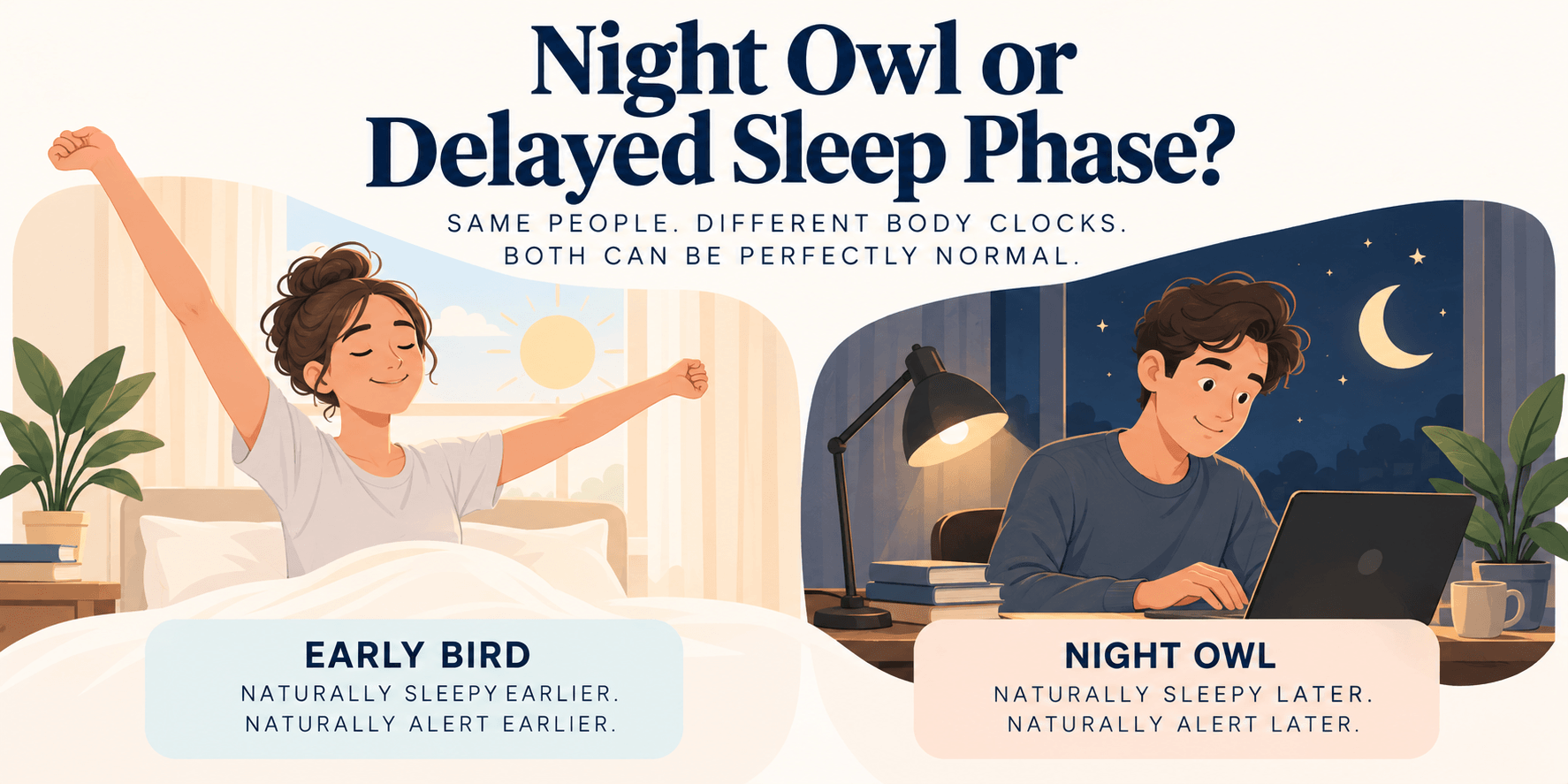
Some people are naturally more alert in the morning. Others do their best thinking late at night. Neither is inherently better or healthier. Your chronotype reflects your biological sleep timing, not your discipline or work ethic.
Some people wake up at 5 AM, go for a run, make breakfast, and accomplish half their to-do list before the rest of us have opened our eyes. Other people are barely functional at 9 AM but can get an astonishing amount of work done at midnight. Guess which group society thinks is more responsible?
We've attached a strange moral value to the time people wake up. Early risers are disciplined and productive. Night owls are lazy, immature, or lacking self-control. But your preferred sleep schedule isn't a measure of your character. It's largely a reflection of your biology. We call that biological preference your chronotype.
And while being a night owl is a perfectly normal variation in human sleep timing, some people have a circadian rhythm that's delayed enough to create significant problems in their lives. That's when we start considering delayed sleep-wake phase disorder, or DSWPD.
So how do you tell the difference between being a night owl and having a sleep disorder?
First, What Exactly Is a Night Owl?
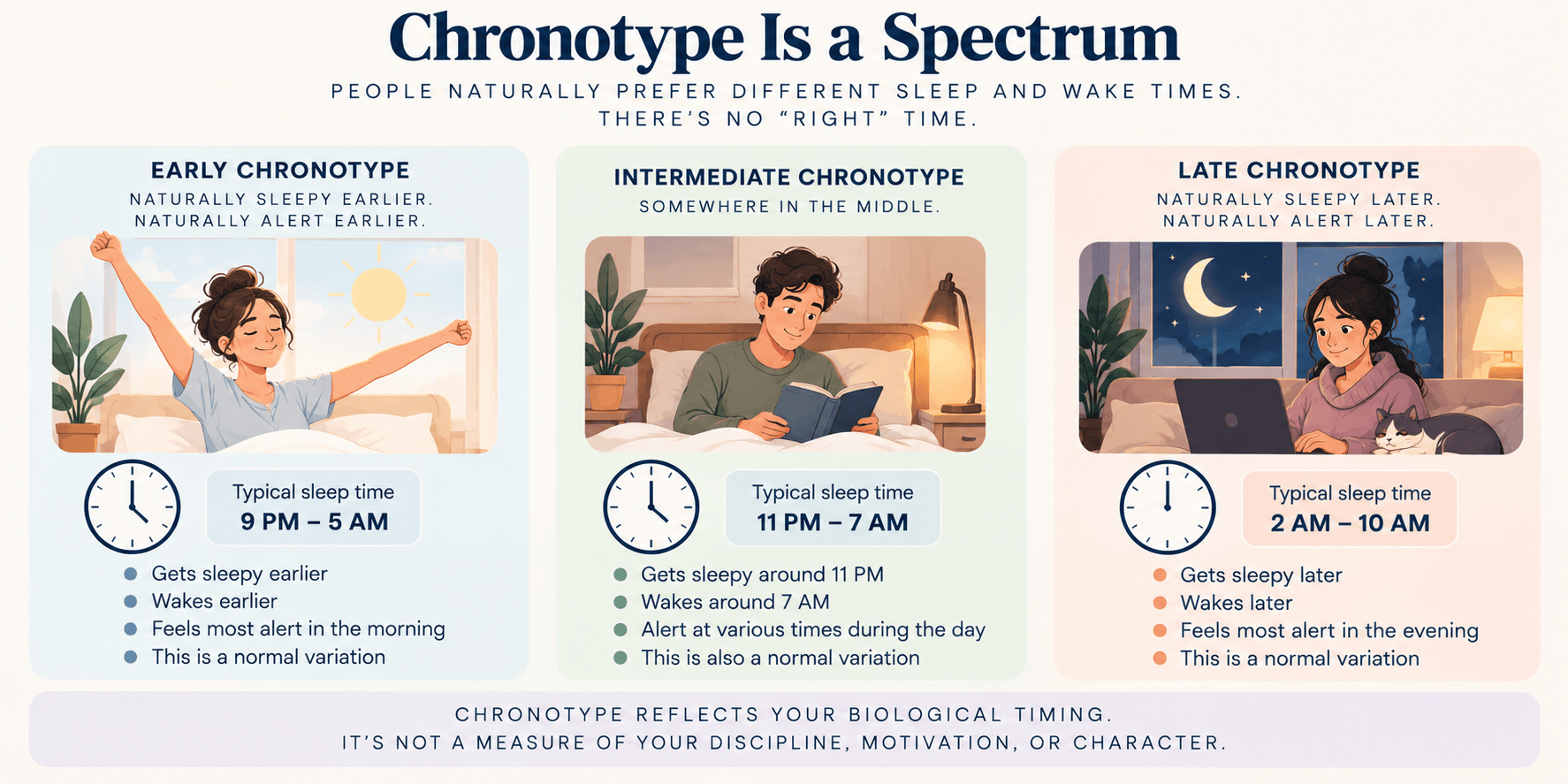
Chronotype exists on a spectrum, from early birds to night owls, with most people falling somewhere in between. These sleep schedules are examples of normal biological variation, not rules about when everyone should sleep.
A night owl is someone with a late chronotype. Your chronotype is your body’s preferred time to sleep and wake. Some people naturally prefer an earlier schedule, others prefer a later schedule, and most fall somewhere in the middle.
This isn't simply a preference in the sense that you prefer coffee over tea. Your chronotype reflects the timing of your circadian rhythm, the internal biological system that regulates when your brain promotes wakefulness and when it promotes sleep.
If you want to understand more about how your internal clock works, I've written a more detailed explanation of circadian rhythms and their disorders.
For someone with an early chronotype, getting sleepy at 9 PM and waking naturally at 5 AM might feel perfectly normal. Someone with an intermediate chronotype might naturally sleep from 11 PM to 7 AM. And someone with a late chronotype might prefer sleeping from 1 AM to 9 AM.
These are examples, not rigid categories. Chronotype exists on a spectrum.
Being a Night Owl Isn't a Bad Habit
People sometimes assume that night owls have trained themselves to stay up late by using their phones, watching television, or refusing to go to bed at a reasonable hour. Behavior certainly can influence sleep timing. But chronotype has a biological component you can't simply explain away as bad habits. Genetics play a role. Age also matters.
During adolescence, the circadian rhythm naturally shifts later. This is one reason teenagers often struggle to fall asleep early and wake up for school. As people move through adulthood, their circadian timing generally shifts earlier again, although some people remain strongly evening-oriented throughout their lives.
Being more alert in the evening isn't inherently unhealthy. The important question is whether your sleep timing works with the rest of your life.
When Does Being a Night Owl Become Delayed Sleep Phase Disorder?
Here's what I want you to take away. A late chronotype isn't a disorder unless it causes you distress or interferes with your ability to function. You could naturally fall asleep at 3 AM and wake up at 11 AM every day. If you're getting enough sleep, functioning well, and happy with your schedule, what's the problem? There may not be one.
But let's say your body wants to sleep from 3 AM to 11 AM, and you have to be at work at 8 AM. Now you're in trouble. You can't fall asleep early enough to get sufficient sleep before your alarm goes off. You're chronically sleep-deprived, struggling to wake up, arriving late to work, or having difficulty functioning during the day. That's when we start considering delayed sleep-wake phase disorder.
The distinction isn't simply how late you stay up. It's whether the timing of your sleep is creating a meaningful problem in your life. We also need to establish that the pattern is persistent and isn't better explained by something else.
The Difference Isn't Just How Late You Stay Up
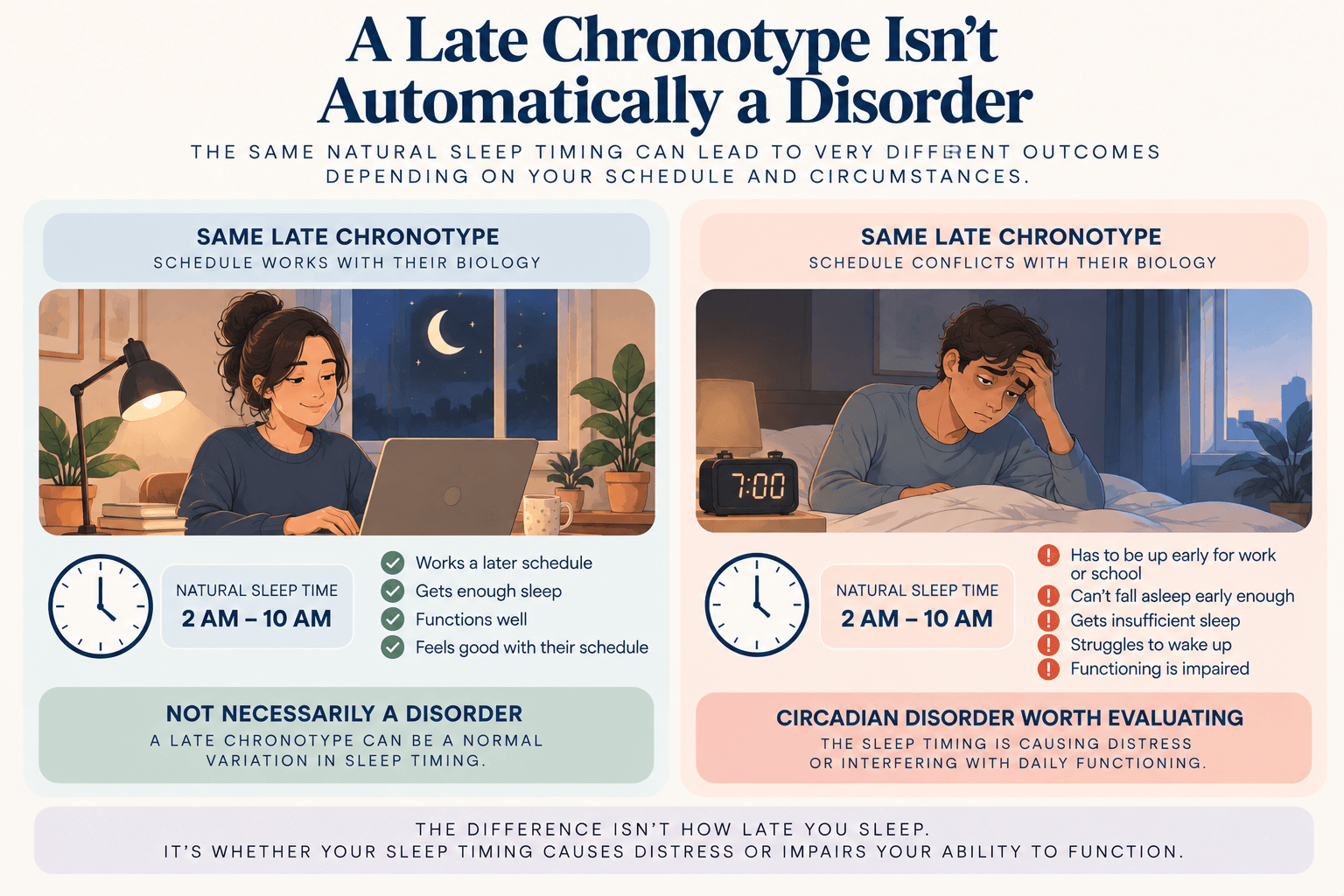
Two people can have the same natural sleep schedule but very different experiences. If your schedule allows you to get enough sleep and function well, there may be nothing to treat. Delayed sleep phase becomes a clinical concern when your sleep timing causes significant distress or interferes with your ability to function.
Imagine two people who both prefer going to bed at 1 AM. One works in a restaurant, gets home late, falls asleep around 1:30 AM, and wakes naturally at 9:30 AM. They sleep well, get enough sleep, and their schedule works for them. The other has to be at work at 7 AM. They try to get into bed at 10 PM, but rarely fall asleep before 1:30 AM. They're chronically sleep-deprived, struggle to wake up, and are frequently late.
Both have a late chronotype. But the second person is experiencing a significant mismatch between their biological sleep timing and their responsibilities. That mismatch is causing problems with their sleep and their ability to function. The first person, meanwhile, may have no reason to change their schedule at all.
This is why I don't think we should treat a late sleep schedule as a problem simply because it's unconventional.
The Question I Ask: When Would Your Body Sleep If You Had No Responsibilities?
When someone comes to me because they can't fall asleep until very late, I ask: If you had no responsibilities, what time do you think your body would prefer to go to sleep and wake up?
This is sometimes a harder question to answer than you'd expect. People are so accustomed to the idea that they should go to bed early and wake up early that they answer with the schedule they wish they could keep. They'll say they want to sleep from 11 PM to 7 AM.
Okay. But that's not what I'm asking. I'm asking when your body wants to sleep. Not when you think a responsible adult should go to bed. Not when your boss expects you to be awake. Not when you wish you could fall asleep.
If you had nowhere to be, no alarm to set, and nobody judging you for sleeping until 11 AM, what schedule would you naturally settle into? That answer tells me something about your circadian timing.
Do You Actually Sleep Well on That Schedule?
Then I ask another question: When you're allowed to follow that schedule, do you sleep well? Let's say you routinely struggle to fall asleep before 3 AM. During the workweek, you get into bed at 11 PM and lie awake for hours. Your alarm goes off at 7 AM, and you're exhausted.
But when you're on vacation, you start going to bed around 3 AM and waking up around 11 AM. And suddenly, you're sleeping pretty well. You fall asleep quickly. You sleep through the night. You get a reasonable amount of sleep and feel more rested. That's a useful clue.
It suggests that you may not have a problem with the ability to sleep. You may have a problem with the timing of sleep. If you still struggle to fall asleep and stay asleep even when you follow your preferred schedule, I start thinking about other sleep problems, including insomnia.
It's also possible to have both insomnia and delayed sleep phase. Sleep disorders aren't mutually exclusive.
Five Clues That Your Night-Owl Schedule May Be a Circadian Rhythm Disorder
There isn't a single question that diagnoses delayed sleep phase. I look at the overall pattern. But these five clues can help you recognize when your late schedule might deserve further evaluation.
1. You Consistently Can't Fall Asleep Until Very Late
We're not talking about occasionally staying up until 2 AM because you're watching a show or working on a project. We're talking about a pattern that persists even when you genuinely want to sleep earlier. You get into bed at 10 or 11 PM, but your brain isn't ready to sleep. You might be exhausted. You might desperately want to fall asleep. But wanting to sleep and being physiologically sleepy are not the same thing.
2. You Sleep Well When You Follow Your Preferred Schedule
This is one of the most informative clues. If you sleep from 3 AM to 11 AM and get eight hours of reasonably consolidated sleep, that tells us something different from someone who sleeps poorly regardless of when they go to bed. Your sleep system may be working just fine. It's the timing that's creating the problem. And if that timing isn't causing distress or interfering with your life, you may not have a disorder at all.
3. Waking Up Early Is Exceptionally Difficult
For someone with a significantly delayed circadian rhythm, waking up at 6 or 7 AM may feel like waking up in the middle of the night. Because, biologically, that's pretty much what they're doing. They may sleep through alarms, struggle to become fully alert, or feel profoundly groggy for hours after waking. And if they're only getting four or five hours of sleep because they can't fall asleep until 2 or 3 AM, sleep deprivation makes everything worse. This isn't necessarily a motivation problem.
4. The Pattern Has Been There for a Long Time
Delayed sleep phase often emerges during adolescence or young adulthood. Someone might tell me they've been a night owl since high school. They struggled to get to school in the morning, felt much more alert late at night, and never really grew out of it. That history matters. A sudden change in sleep timing after starting a new job, taking a medication, or experiencing a stressful event may have a different explanation. We're looking for a persistent pattern, not just a bad week of sleep.
5. Your Sleep Schedule Is Causing Distress or Interfering With Your Life
This is the distinction I don't want people to miss. You can have a late chronotype without having a disorder. If you naturally sleep from 2 AM to 10 AM, get adequate sleep, function well, and feel fine about your schedule, there's no reason to assume something is wrong. But if your timing causes chronic sleep deprivation, repeated lateness, problems at work or school, or significant distress, that's a different situation. A circadian rhythm disorder isn't diagnosed because society thinks you should wake up earlier. We consider a disorder when the sleep timing problem is persistent and has meaningful consequences.
Can You Be a Night Owl Without Having a Sleep Disorder?
Absolutely. In fact, I think it's important that we stop treating every unconventional sleep schedule as something that needs to be corrected. Imagine someone who naturally sleeps from 2 AM until 10 AM. They work an afternoon or evening schedule. They sleep eight hours, wake up feeling reasonably rested, and have enough energy to do what they need to do.
What's the problem? There may not be one. The fact that someone else gets up at 5 AM doesn't make that person's sleep healthier or more virtuous. And forcing a naturally late sleeper onto an early schedule simply because we think early rising is better can create problems that weren't there before.
Sometimes It's Better to Build Your Life Around Your Chronotype
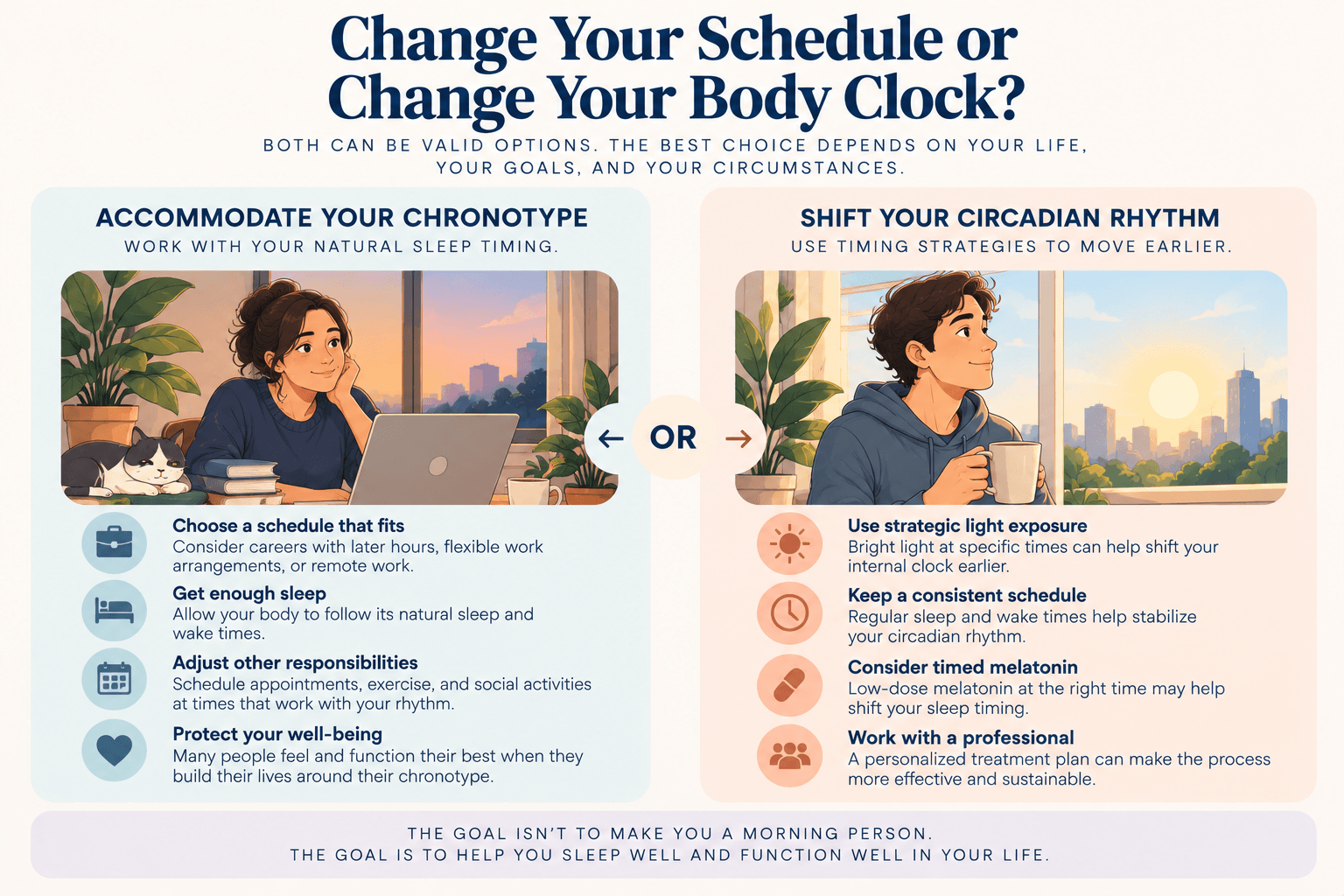
Treatment doesn't always have to mean shifting your circadian rhythm earlier. If you can build your life around your natural sleep schedule, that may be the better option. When that's not possible, strategically timed light, consistent scheduling, and other interventions can help shift your body clock.
We tend to assume that if someone's circadian rhythm runs late, the solution is to shift it earlier. But that's not necessarily the best option. If you're naturally inclined to sleep from 2 AM to 10 AM, and you can arrange your work and other responsibilities around that schedule, why not? Some people choose careers with later hours, negotiate flexible work schedules, or otherwise structure their lives to accommodate their natural sleep timing. And that can be preferable to trying to advance their circadian rhythm.
Advancing a delayed rhythm takes work. You have to be consistent with the timing cues that keep your body clock on track. And depending on your biology, maintaining that earlier schedule may continue to require effort. If you can build a life that accommodates your chronotype, allows you to get enough sleep, and doesn't cause you distress, that's a perfectly reasonable option.
Of course, not everyone has that flexibility. School, work, family responsibilities, and other obligations may require someone to be awake much earlier than their body naturally prefers. When the mismatch is causing problems and changing the schedule isn't feasible, that's where treatment to advance the circadian rhythm becomes useful.
The goal isn't to make you a morning person. The goal is to help you sleep well and function well in your life.
How Do We Figure Out Whether It's Delayed Sleep Phase?
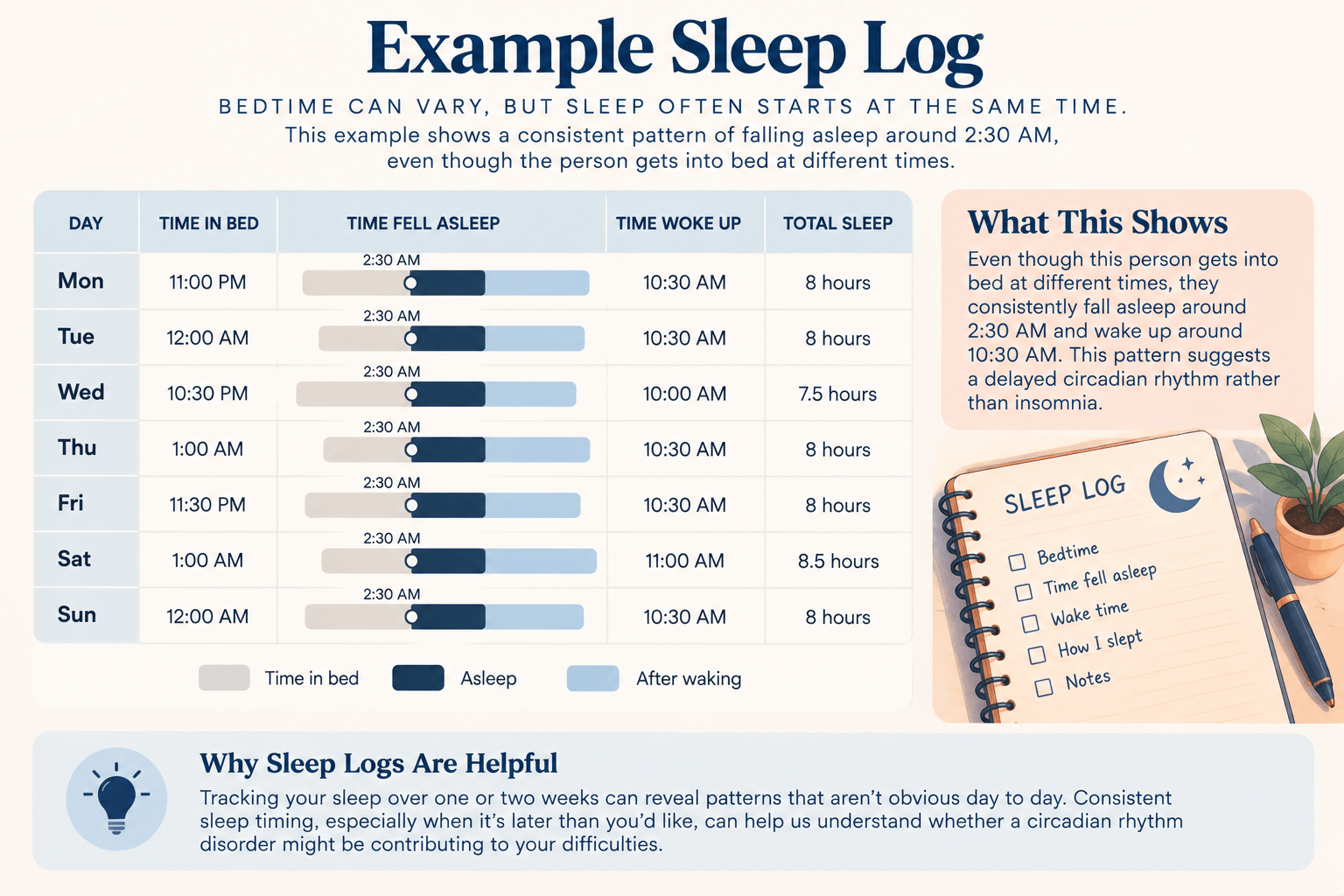
Going to bed earlier doesn't necessarily mean falling asleep earlier. This example sleep log shows someone consistently falling asleep around 2:30 AM, regardless of when they get into bed. Tracking sleep patterns over one to two weeks can help identify whether circadian timing may be contributing to sleep difficulties.
In addition to asking about your sleep history, I use sleep logs. These are daily records of when you fall asleep, when you wake up, and other aspects of your sleep. Over a week or two, patterns often become clearer.
Maybe you consistently fall asleep around 2:30 AM, regardless of whether you get into bed at 10 PM, midnight, or 2 AM. Maybe your sleep becomes much more consolidated when you stop trying to force an earlier bedtime. Maybe you sleep well on days off but struggle during the workweek because your alarm goes off hours before your body wants to wake up. All of that helps us understand what's happening.
Sleep logs don't tell us everything, and sometimes additional evaluation is appropriate. But they're often much more useful than simply asking whether you're getting eight hours of sleep. We need to know when you're sleeping, not just how much.
What If You Want to Change Your Sleep Schedule?
Being a night owl doesn't mean you're doomed to struggle with morning responsibilities forever. But shifting a circadian rhythm isn't the same thing as deciding to be more disciplined. Your brain uses environmental timing cues, called zeitgebers, to synchronize its internal clock with the outside world.
Light is the most powerful of these cues. Strategically timed light exposure, carefully timed melatonin, consistent sleep and wake schedules, and other behavioral interventions may help shift a delayed rhythm earlier.
The timing of these interventions matters. Bright light at the wrong time can shift your clock later instead of earlier. And simply going to bed several hours earlier than your body is ready for sleep isn't treatment. It's a good way to spend several hours lying awake and getting frustrated.
For a closer look at what that experience can mean, read Why Can't I Fall Asleep Until 3 or 4 AM? It Might Not Be Insomnia.
The goal of treatment isn't to turn everyone into a morning person. It's to help you establish a schedule that works with your responsibilities while still allowing you to get adequate sleep. And if your existing schedule already does that, you may not need to change it.
Your Chronotype Isn't a Character Flaw
If you've spent years being told that you're lazy because you sleep late, I want you to consider another possibility. Maybe your brain is simply operating on a different schedule. That doesn't mean your sleep timing can't create problems. It can. And it doesn't mean we can't do anything to help you shift it.
But understanding the biology changes the conversation. Instead of asking why you can't just make yourself go to bed earlier, we can start asking what your circadian rhythm is actually doing and whether it needs to change. That's a much more useful question.
Delayed Sleep Phase Treatment in Austin
If you've always considered yourself a night owl and your sleep schedule is making it difficult to function, it may be worth evaluating whether you have delayed sleep-wake phase disorder. I provide delayed sleep phase treatment in Austin for adults whose internal sleep timing doesn't line up with the schedule they need or want to maintain.
Treatment starts with understanding your actual sleep pattern, not simply telling you to go to bed earlier. Because there's nothing inherently wrong with being a night owl. You can work on changing your body clock, or you can sometimes change your life to accommodate it. Either way, the goal is to get enough sleep and function well.
About the Author
Jessica Fink, LCSW-S, is a therapist in Austin, Texas, who specializes in treating sleep disorders in adults. Her approach combines evidence-based behavioral sleep interventions with an understanding of how biological sleep timing affects everyday life.
Learn more about Jessica Fink and her practice.