Why Can't I Fall Asleep Until 3 or 4 AM? It Might Not Be Insomnia
It's 11 PM. You have to get up at 7 AM, so you decide to go to bed. You’re not sleepy at all. You lie there for a while, hoping sleep will come. You check the clock. It's midnight. You start making the calculations in your head. If you fall asleep right now, you can still get seven hours. That’s workable.
By 1 AM, you're getting really frustrated. By 2 AM, you're making predictions about how awful you’re going to feel tomorrow. Finally, around 3 or 4 AM, you fall asleep. When your alarm goes off a few hours later, you were finally sleeping pretty well. Now you are absolutely dragging. Getting out of bed feels impossible. You spend the day exhausted, hoping tonight will be better. Except tonight, it’s the same story all over again.
Most people would assume this is insomnia. And it certainly looks like insomnia. You take forever to fall asleep, you're not getting enough sleep, and you’re paying for it the next day. But what if your brain is perfectly capable of sleeping, just not when you want it to? That’s not insomnia. That’s called delayed sleep-wake phase disorder, or DSWPD.
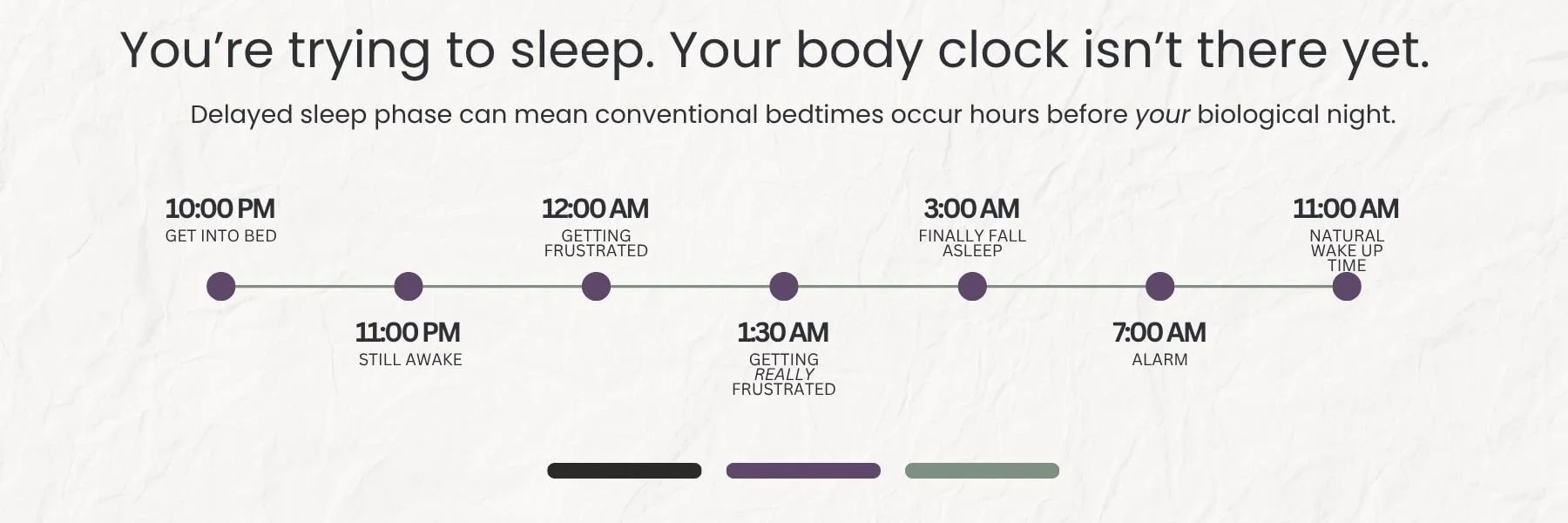
You can be exhausted and desperately want to sleep while your circadian system is still promoting wakefulness. Going to bed earlier doesn't necessarily make your brain ready to sleep earlier.
You're Exhausted. So Why Aren't You Falling Asleep?
When someone tells me they're exhausted, I want to distinguish whether they are tired or sleepy. I know we use the terms interchangeably, but they are not the same. Sleepy means you have a high likelihood of falling asleep. You might notice your eyelids getting heavy, your concentration lapsing, or your head starting to nod. Sleepiness is relieved by sleep. Tired means you're fatigued. You have low energy. You're dragging ass. You might want to lie down, but you’re unlikely to fall asleep if you do. It’s possible to be tired without being sleepy.
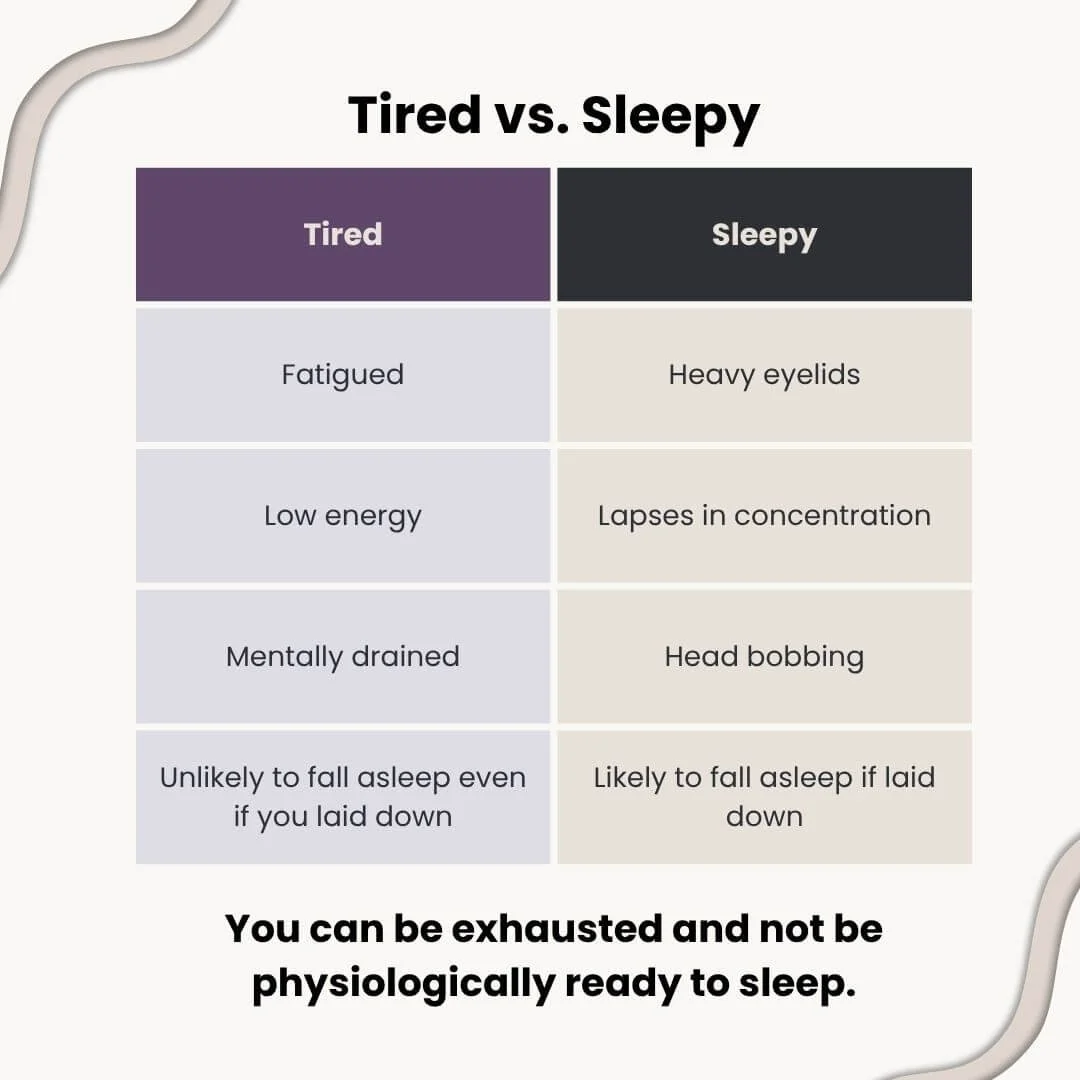
Tired and sleepy aren't the same thing. You can be completely exhausted at 10 PM without actually being sleepy yet.
I wrote a whole blog post about the difference between tired and sleepy and what to do with each: Difference Between Tired and Sleepy.
Your sleep is regulated by two major biological processes: the sleep drive and the circadian rhythm. Sleep drive is homeostatic. The longer you're awake, the more pressure you build for sleep. It's a lot like hunger. The longer you go without eating, the hungrier you get. Your circadian rhythm is your body's internal timing system. It determines when your brain promotes wakefulness and when it promotes sleep.
Someone with delayed sleep phase who goes to bed at a conventional time isn’t falling asleep, in part, because their brain is still promoting wakefulness. Going to bed does not induce sleepiness.
For a more detailed explanation of how these two systems work, read Circadian Rhythm Disorders: When Your Body Clock Doesn't Match Your Life.
Your Body Clock Might Be Running Later Than Everyone Else's
We all have a preferred window of time for sleeping and waking. This is called your chronotype. Some people are morning types. They naturally get sleepy early in the evening and wake up early in the morning. Others are evening types. They don't become sleepy until much later and naturally prefer to wake up later. Most people fall somewhere in the middle.
There is nothing inherently wrong with being a night owl. The problem arises when your preferred sleep schedule is so late that it interferes with your ability to meet the demands of your life. When that happens, we may be looking at delayed sleep-wake phase disorder.
Your Brain Doesn't Know That You Have to Be at Work at 8 AM
The biological process that influences when you fall asleep is called your dim-light melatonin onset, or DLMO. Melatonin is a hormone that helps signal biological nighttime. Your brain begins producing it about two hours before the time you tend to fall asleep. For someone with a conventional sleep schedule, melatonin might begin rising around 9 PM, with sleep following a couple of hours later.
For someone with delayed sleep phase, that process happens later. Their melatonin may not begin rising until 11 PM or midnight, and their preferred sleep onset might be 2 or 3 AM. Now imagine telling that person they need to go to bed at 10 PM.
That's like telling someone with a conventional circadian rhythm to go to bed at 7 PM. You could turn off all the lights, put your phone away, get into your pajamas, and lie down. Your brain would be like, What the hell are we doing? It's not time to go to bed yet!
You can want to sleep as badly as you've ever wanted anything. But wanting to sleep and being physiologically ready to sleep are two different things. This is why telling someone with delayed sleep phase to just go to bed earlier is useless advice.
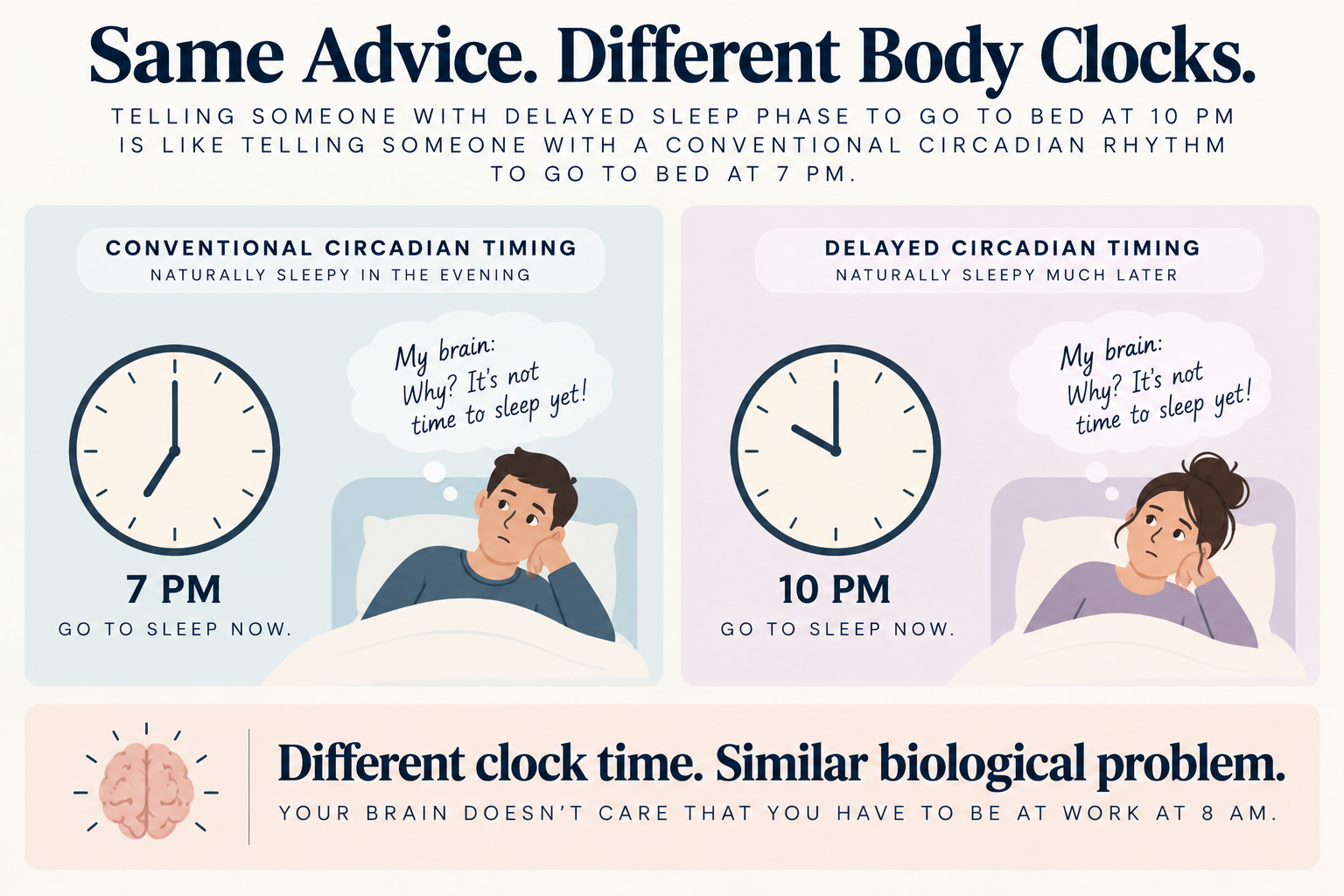
Your brain doesn't know you have to be at work at 8 AM. For someone with delayed sleep phase, a 10 PM bedtime can feel biologically more like 7 PM does to someone on a conventional schedule.
Signs That You Might Have Delayed Sleep Phase
Delayed sleep phase isn't simply a preference for staying up late. It's a biologically based sleep disorder in which your internal sleep schedule is significantly later than the schedule you need or want to maintain.
Some common signs include:
You rarely feel sleepy before 1 or 2 AM, and sometimes not until 3 or 4 AM. Or maybe even later.
You have tremendous difficulty waking up at conventional morning hours.
You struggle to get enough sleep when you have work, school, or other morning responsibilities.
You naturally sleep much later when you don't have to set an alarm.
You fall asleep more easily and sleep better when you're allowed to follow your preferred schedule.
That last point is particularly important. Someone with delayed sleep phase often doesn't have a problem with the ability to sleep. They have a problem with the timing of sleep. When their schedule is compatible with their circadian rhythm, they may fall asleep quickly, sleep through the night, and get a normal amount of sleep. It's when they try to force their sleep into a conventional schedule that everything falls apart.
What Happens When You Don't Have to Set an Alarm?
One of the questions I ask during an intake is: If you had no responsibilities, what time do you think your body would prefer to go to sleep and wake up?
Sometimes it takes some doing to get to the right answer because we’re all so programmed to want to go to bed and get up early. Society favors that schedule. I’m not necessarily asking what time you want to go to bed and wake up. I’m asking what time your body wants to go to bed and wake up, which may be quite different from the schedule you wish you could keep.
Once we’ve pinned down a good estimate, I also ask whether the person sleeps well when they're able to follow that schedule. Think about what happens when you're on vacation or have several days off. Do you naturally start going to bed at 3 AM and waking up at 11 AM? And when you follow that schedule, do you fall asleep fairly quickly and sleep through the night? Or do you still spend hours trying to fall asleep, even when you get into bed at the time your body seems to prefer?
These questions help me distinguish between someone who can't sleep and someone who can't sleep at the times they want.
What Sleep Logs Can Tell Us
In addition to asking about your history, I also use sleep logs to evaluate a possible circadian phase delay. I have you track what time you fell asleep and what time you woke up, among a few other metrics. Over a week or two, I can start to see the pattern. Someone might spend three hours trying to fall asleep when they get into bed at 10 PM. But on a night when they go to bed at 2 AM, they're asleep in 15 minutes. When they can wake up naturally, they sleep through the night and feel pretty rested. That points more to a phase delay than insomnia.
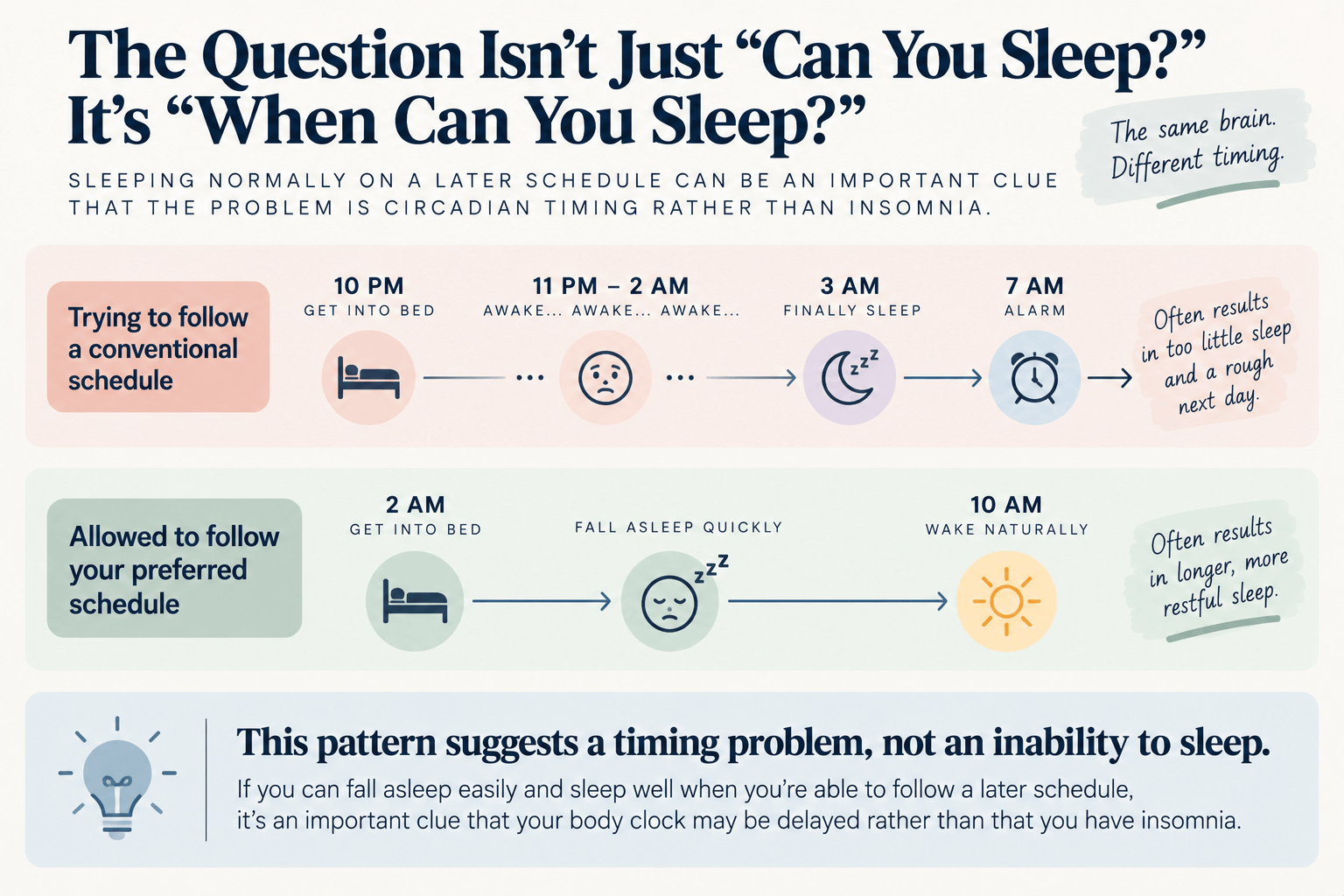
The question isn't just whether you can sleep. It's when you can sleep. Sleeping well on a later schedule is an important clue that the problem may be circadian timing rather than insomnia.
It suggests that the problem may not be an inability to sleep. The person is attempting to sleep at a time when their circadian system is still promoting wakefulness and trying to wake up when their system is still promoting sleep. Of course, a late sleep schedule alone isn't enough to diagnose a circadian rhythm disorder. We also need to consider how long the pattern has been present, whether it's causing impairment, and whether something else could explain the sleep difficulty.
But understanding what happens when someone follows their preferred schedule is a good place to start.
Why Going to Bed Earlier Can Actually Make Things Worse
Let's say your body naturally wants to fall asleep around 3 AM. But you have to be at work at 8 AM, so you decide you're going to go to bed at 10 PM. Now you're spending five hours in bed before your body is ready to sleep. What’s happening during those five hours? Not sleep.
You get irritated. You start worrying about how little sleep you're going to get. You check the clock and predict how terrible tomorrow is going to be. Eventually, you start dreading bedtime because you know what's coming. This is where an insomnia problem can develop on top of a circadian problem.
Your Brain Can Learn to Associate Your Bed With Being Awake
Our brains learn through association. If you consistently get into bed when you're sleepy and fall asleep relatively quickly, your bed becomes associated with sleep. But if you spend hours in bed wide awake, frustrated, and trying desperately to make yourself sleep, your brain starts learning a different association. Bed becomes a place where you lie awake, worry, and struggle. We call this conditioned arousal.
It's the same basic principle as Pavlov's dogs, except instead of learning to salivate when a bell rings, your brain has learned that getting into bed means it's time to be wide awake and stressed out. Now you potentially have two problems: delayed sleep phase and insomnia. And treating one doesn't automatically resolve the other.
Delayed Sleep Phase and Insomnia Require Different Treatments
Insomnia is generally treated with cognitive behavioral therapy for insomnia, or CBT-I. This treatment addresses the behaviors and thought patterns that perpetuate sleep problems. Delayed sleep phase requires interventions that directly target the circadian system. When someone has both, I address the insomnia that has developed on top of the phase delay before attempting to shift the circadian rhythm. This is why it's important to understand what's actually causing the sleep problem instead of assuming that everyone who struggles to fall asleep has insomnia.
What Actually Helps When You Can't Fall Asleep Until 3 or 4 AM?
If your problem is delayed sleep phase, the goal is to shift your circadian rhythm so your body is ready to sleep at a time that works better for your life. We do this by manipulating the timing cues that your brain uses to determine what time it is. These cues are called zeitgebers, a German word meaning “time givers.”
Light is the most powerful zeitgeber, but the timing of social interactions, meals, physical activity, and other daily routines can also influence your circadian system. Have you ever had jet lag? It’s not just being tired. It’s circadian disruption caused by a drastic change in the timing of your zeitgebers. You can adjust, but it takes time.
Treatment of a phase delay may involve the following.
Carefully Timed Light Exposure
Light tells your brain what time it is. Exposure to light at certain times can shift your circadian rhythm earlier, while light at other times can shift it later. For someone with delayed sleep phase, strategically timed morning light and reducing light exposure at the wrong time may help shift the clock earlier. But timing is everything. Using bright light at the wrong time can actually push you even later, which is the opposite of what we want.
Consistent Sleep and Wake Times
Your circadian system responds to consistency. If you wake up at 7 AM during the week and noon on the weekends, you're giving your brain conflicting information about what time it is. You might as well be flying from New York to Alaska and then back to New York every weekend. We actually call erratic bed and wake times without the travel “social jet lag” because it’s effectively the same thing as far as your brain is concerned. We always start with stabilizing the bed and wake time before trying to advance the rhythm.
Strategically Timed Melatonin
Melatonin is often marketed as a sleeping pill, but that’s not what it is. It’s not a hypnotic; it’s a chronobiotic. This means it generally will not sedate you or induce sleep. Instead, it can help shift the timing of your sleep onset earlier if you take it at the right time, which is often significantly earlier than bedtime. You really have to time it right, just like the light exposure. This is something to work out with a qualified healthcare professional rather than experimenting with increasingly large doses.
For a deeper dive into melatonin, check out: Can Melatonin Help With Insomnia?
Behavioral Changes
The timing of your daily activities also matters. Regular meals, physical activity, and other consistent routines can help reinforce your circadian schedule. Treatment is individualized because the goal isn't simply to make everyone sleep from 11 PM to 7 AM. It's to develop a sleep schedule that is both biologically achievable and compatible with your life.
Sleep Hygiene Isn't Going to Fix a Circadian Rhythm Disorder
If you've been struggling to fall asleep for years, you've probably received plenty of sleep hygiene advice. Make your bedroom cold and dark. Avoid caffeine. Put your phone away. Develop a relaxing bedtime routine. None of these things are inherently bad. They're just not treatment for a circadian rhythm disorder (or insomnia, for that matter).
I like to compare sleep hygiene to dental hygiene. Brushing and flossing can help prevent cavities. But once you have a cavity, brushing your teeth more often isn't going to fill it. You need treatment.
The same principle applies to sleep disorders. You can have impeccable sleep hygiene and still have a circadian rhythm that's several hours later than the schedule your life requires. If the problem is your internal timing system, that's the system we need to address.
You Aren't Lazy Because You Can't Wake Up at 7 AM
People with delayed sleep phase often spend years being told that they need to be more disciplined. Just go to bed earlier. Stop staying up so late. You're a grown adult. Get yourself out of bed. I've had clients whose coworkers give them side-eye for coming into work later. Parents sometimes interpret a young adult's late sleep schedule as irresponsibility or defiance.
But if your body naturally wants to sleep from 3 AM until 11 AM, waking up at 7 AM isn't simply a matter of motivation. You're trying to wake up when your brain still considers it biological nighttime. And if you've only been asleep for four hours, you've also got a substantial amount of sleep deprivation to contend with.
A delayed sleep schedule can create real problems, but it isn’t a character flaw. I find at least some part of this work is destigmatizing running on a later schedule.
Delayed Sleep Phase Treatment in Austin
If you regularly can't fall asleep until 3 or 4 AM, pay attention to what happens when you don't have to follow a conventional schedule. Do you sleep well when you can go to bed and wake up at the times your body prefers? If so, it may be worth evaluating whether you have a circadian rhythm disorder rather than assuming you have insomnia.
I provide delayed sleep phase treatment in Austin for adults whose internal sleep timing doesn't match the schedule they need or want to maintain. Treatment focuses on understanding your sleep patterns and using behavioral and circadian interventions to help stabilize or shift your body clock.
You don't need to learn how to sleep. You need to teach your brain to sleep at a more optimal time.
About the Author
Jessica Fink, LCSW-S, has been in the mental health field since 2007. Following over a decade at a psychiatric hospital, she opened a private practice that specializes in sleep disorders. Jessica treats insomnia, hypersomnia, nightmares, difficulty with PAP, and, of course, circadian rhythm disorders. She is a member of the American Academy of Sleep Medicine and the Society of Behavioral Sleep Medicine.