When Should You See a Therapist for Nightmares?
We all have nightmares from time to time. Usually it’s a one-off, “what the hell, brain?”, that’s forgotten about by mid-morning. But for some people it becomes something more.
For these folks, what is an occasional annoyance for many of us becomes a chronic and life-altering problem. That leads people to ask, “Should I see someone about this?” If you're asking yourself that question, I lean toward yes.
In addition to treating nightmares, I also do a lot of CBT for Insomnia. A core tenet of CBT-I is getting out of bed when you can't sleep. Inevitably, people ask me, “But how do I know when I should get out of bed?” If you're lying there asking yourself, Should I get out of bed?—it's probably time to get out of bed.
Nightmares are similar. If they're disrupting your sleep or your life enough that you're Googling whether you should see a therapist about them, you’ve landed in the right place. Allow me to support you in making this decision.
Occasional Nightmares Are Normal
Having a nightmare doesn't automatically mean you have a disorder. Many people have them occasionally. You might be going through an unusually stressful week or watch something disturbing before bed, and it comes out in your dreams.
So when does it become a problem? I’ll list the criteria here, and I'll break them down further in the next section. Please note you do not need to meet all of them.
The nightmares are happening at least once a week for at least a month.
They regularly wake you up.
You have trouble getting back to sleep after a nightmare.
You feel rough the next day.
You’ve started taking measures to prevent the next nightmare (avoiding sleep, sleeping with the lights on, using cannabis to suppress REM).
How Do I Know If My Nightmares Are a Problem?
Here is a walkthrough of how I assess the severity of the nightmare problem.
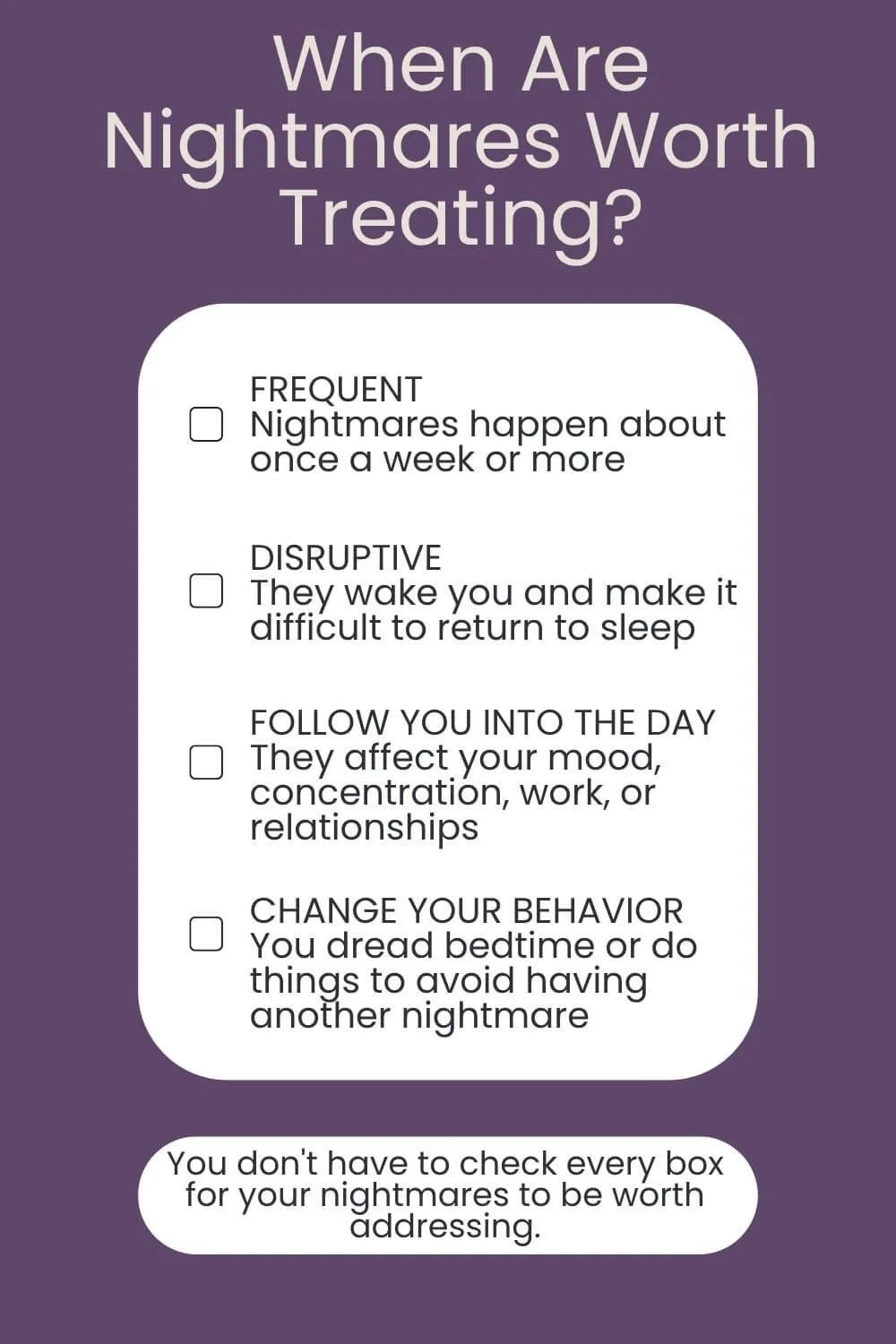
Nightmares may be worth treating when they happen regularly, disrupt your sleep, affect you during the day, or cause you to change your behavior to avoid them. You don't have to check every box to ask for help.
You're Having Nightmares About Once a Week or More
If you're averaging at least one nightmare per week, that's notable. We’re also looking for this to persist for at least one month. Sometimes they come in cycles, but if we averaged them out and it would add up to at least one per week, treatment is worth considering. I’m looking for a chronic and enduring pattern, not a short-lived cluster of nightmares that shows up temporarily during a stressor.
Your Nightmares Wake You Up Regularly
If nightmares are waking you up at least once a week, we’ve now got an additional problem. Your sleep is being disrupted, too. And it’s not a gentle awakening. Even though you quickly realize it was a dream, it takes a long time to come back down. Plus, if you do get back to sleep, the nightmare might just pick up where it left off! So over time, what started as a nightmare problem also becomes an insomnia problem.
Your Nightmares Are Affecting Your Life While You're Awake
Sleep disorders are 24-hour disorders. They’re not just messing you up at night. Both insomnia and nightmares will result in all kinds of fallout during the day. From exhaustion because you didn’t get enough sleep the night before, to struggling to concentrate at work, to increased irritability with the people you love, to absolutely dreading bedtime the following night. It all compounds on itself.
For a more in-depth look at nightmare causes and treatments, read Why You Don’t Have to Live With Chronic Nightmares.
“But My Nightmares Are the Least of My Problems”
I ask all of my sleep clients, regardless of the reason they are seeing me, if they have nightmares. They’re surprisingly common. And a lot of these people say, “Honestly, nightmares are the least of my issues right now.” And sometimes that's truly the case, and I would never mandate that someone treat their nightmares.
But humans are adaptable, for better and for worse. I always wonder if people have just decided nightmares are an inescapable part of their life now and thus have convinced themselves that they really aren’t that big of a problem. We all do this with problems that feel insoluble. We convince ourselves it isn’t that bad. It makes it easier to live with.
People can live with nightmares for years completely unaware that there are effective treatment options. I never force it on anyone, but I do make sure they know that they have options. Should someone choose not to pursue it, that’s okay. I’d rather that than someone erroneously assuming nothing can be done.
First, Let's Make Sure They're Actually Nightmares
You wake up panicked and hyperventilating. You MUST have had a nightmare, right? But what if you don’t recall any dream content?
This is critically important because if you can’t remember even some detail of a dream, we need to consider other causes for these abrupt awakenings.
Nightmares Are Usually Remembered
People remember nightmares. Maybe not every single detail, but enough that you could more or less tell the narrative of the dream to another person. If there is no recollection of anything resembling a story, I’m going to consider another explanation.
Nightmares and Night Terrors Aren't the Same Thing
People often use nightmare and night terror interchangeably, but they're very different sleep disorders.
Both nightmares and night terrors are considered parasomnias. The prefix para- means “alongside,” so parasomnias are events that happen alongside sleep. In diagnosing a parasomnia, we start by looking at when in the night it happens in addition to how it presents.
Nightmares are disturbing dreams that wake you up. They occur predominantly during REM sleep, which becomes more prevalent in the second half of the night. People generally wake from nightmares alert and able to remember at least some of the dream.
Night terrors are different. They occur out of deep sleep, tend to happen earlier in the night, and usually aren't remembered afterward. Someone may scream, flail, or appear terrified without actually waking fully.
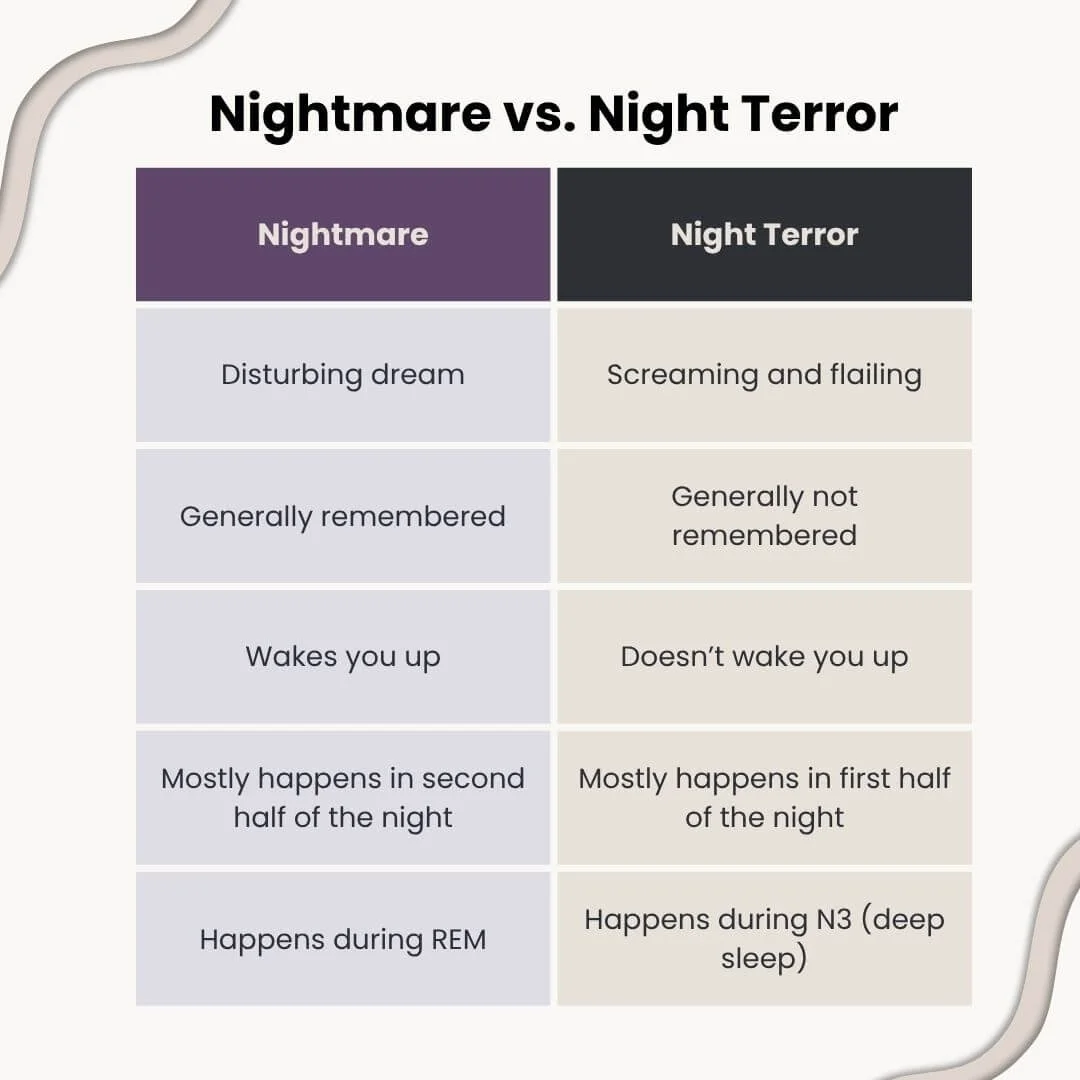
Nightmares and night terrors aren't the same thing. Nightmares are usually remembered after waking, while night terrors occur during deep sleep and typically aren't remembered. If you wake up frightened with no memory of a dream, it's worth considering other explanations.
There is a treatment for night terrors called scheduled awakenings. It’s very different from CBT for Nightmares.
There is also something called REM Behavior Disorder where people act out their dreams, usually violently. In REM, we are supposed to be paralyzed to prevent harm to ourselves or others, but in some people, this mechanism fails.
If you're physically acting out your dreams—especially kicking, punching, jumping out of bed, or injuring yourself or someone else—talk to your doctor. This warrants medical evaluation rather than assuming you're simply having nightmares.
Waking Up Panicked Doesn't Always Mean You Had a Bad Dream
If you're waking up suddenly in a panic without remembering a dream, I consider nocturnal panic attacks or sleep apnea.
A panic attack is a sudden and intense rush of fear and adrenaline. It peaks quickly and is usually short-lived. They can happen at night, but in my clinical experience, people having nocturnal panic attacks often also report panic attacks during the day. If you aren't having daytime panic attacks, I'm going to consider other explanations.
Sleep apnea is a disorder in which you stop breathing during sleep. Apnea means “no breath.” Most sleep apnea is obstructive, meaning you are trying to breathe, but your airway is blocked. When you stop breathing, your brain wakes you up so you can start breathing again. You then fall back asleep until the next time breathing stops, and you are woken up. Over and over through the night.
This is incredibly stressful for your body. Have you ever had to slam on your brakes to narrowly avoid an accident? And you have this surge of activation that takes a minute to come down? That’s what’s happening when you stop breathing in your sleep. It feels a lot like a panic attack, but there’s a different cause.
Why I Screen for Other Sleep Disorders
When someone comes to me for nightmare treatment, I'm not only assessing the nightmares. I'm looking at the full picture of their sleep. I screen everyone for sleep apnea and narcolepsy, and if what I'm hearing suggests that a sleep study or medical evaluation would be appropriate, I'll recommend that.
Some people see reductions in nightmares once their sleep apnea is adequately treated. That said, crappy sleep is a barrier to using CPAP regularly. We can start working on the nightmares while you're figuring out the sleep apnea piece.
CBT for Nightmares can also be used for nightmares associated with narcolepsy, with some modifications.
What If My Nightmares Are Related to Trauma?
Trauma is often the source of chronic nightmares. You might be wondering if you should pursue a trauma treatment rather than a nightmare treatment.
There are two scenarios where CBT-N is appropriate for trauma-related nightmares.
The first is when nightmares stick around following completion of a trauma treatment. The second is when someone doesn’t feel ready to take on a trauma treatment but would still like some symptom relief. We can at least tackle the nightmare part of it. Plus, getting better sleep may make whatever you decide to work on next feel a little more manageable.
If you're wondering whether having nightmares automatically means you have unresolved trauma, I've written more about that in Are Nightmares a Sign of Trauma? Not Always.
What Happens If I Decide to Get Help?
The first thing I want to do is understand what's happening.
Are these nightmares?
How frequently are they occurring?
How much are they interfering with your life?
Is insomnia part of the picture?
Are there signs of another sleep disorder that should be evaluated?
If CBT for Nightmares is appropriate, treatment is highly structured and typically takes about six sessions. We start with education about sleep and nightmares, improve sleep habits, and institute a relaxation practice. Then we get to the meat: exposure, rescripting, and imagery rehearsal. If you also have insomnia, I’ll incorporate tools from CBT-I.
I've written a whole article about How CBT for Nightmares Works: A Behavioral Approach to Nightmare Treatment if you'd like to know exactly what to expect.
I'm not going to spend six sessions trying to interpret what your dreams secretly mean. We're going to work on changing them.
You Don't Have to Wait Until It Gets Worse
So, should you see a therapist for nightmares? If you’ve made it this far in the post, probably.
Certainly if they're happening at least once a week. Certainly if they're regularly waking you from sleep. And certainly if they're affecting your sleep, mood, work, relationships, or the way you live your life.
If you're dreading bedtime because of your dreams, if you're changing your behavior to try to avoid them, if you've been living with them for years because you assumed there wasn't anything anyone could do, or if you're simply sitting there thinking:
“Are my nightmares bad enough that I should talk to someone?”
It’s worth exploring.
Nightmares Are Treatable
One of the reasons I wanted to write this entire series is that so many people don't realize chronic nightmares are treatable. They assume the nightmares are something they just have to live with. Or that they need to spend years in therapy uncovering their meaning. Or that if trauma caused them, the nightmares can't improve until every aspect of the trauma has been resolved. None of those things are necessarily true.
Nightmares can become learned patterns. And learned patterns can change. The brain learned something. The brain can learn something different.
If you'd like a broader overview of why nightmares become chronic and how they're treated, you can read Why Do I Keep Having the Same Nightmare?
And if recurring nightmares are disrupting your sleep or your life, you can learn more about my Nightmare Disorder Treatment in Austin.
Nightmares are miserable. And they’re optional.
About the Author
Jessica Fink, LCSW-S, is a therapist in Austin who specializes in sleep disorders. She has specialized training in CBT for Nightmares, CBT for Insomnia, and other behavioral interventions for sleep disorders. Prior to being a sleep specialist, she had over a decade of experience in mental health.