How CBT for Nightmares Works: A Behavioral Approach to Distressing Dreams
If you’ve had nightmares for years, you might assume treating them will take an equivalent amount of time. It won’t.
Cognitive Behavioral Therapy for Nightmares (CBT-N) gets it done in approximately six sessions. And we aren’t spending those six sessions endlessly analyzing your dreams or trying to uncover what every detail means. We’re doing something much more practical. We’re interrupting an ingrained pattern and carving a new path.
Now, short and direct does not mean easy. The part people tend to be most nervous about is exactly what you’d expect: we are going to face the nightmare directly. But we don’t start there.
There’s a process, and by the time we get to the harder stuff, we’ll have built a foundation of skills and good habits.
Here’s what CBT for Nightmares actually looks like.
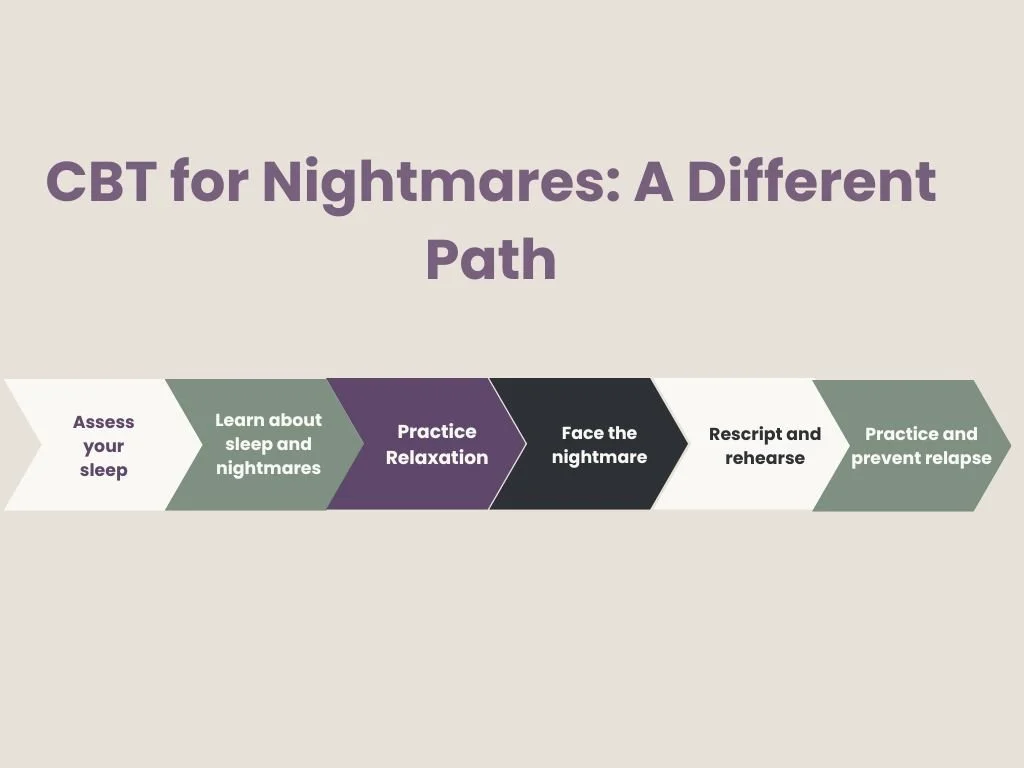
CBT for Nightmares is a short, structured treatment. We start by understanding your sleep, then build skills and gradually work toward facing and rescripting the nightmare.
Step 1: We Start With Your Sleep, Not Just Your Nightmares
The first session is an intake. Before I start treating your nightmares, I want to get a full picture of the problem. How often are you having nightmares? Do they wake you up? Are they significantly interfering with your life or your sleep?
I’m also assessing for other sleep problems because sleep disorders like to bring their friends to the party, and each “friend” needs its own treatment. For example, lots of people have insomnia, sleep apnea, or restless legs in addition to their nightmares.
I want to get a sense of everything that could be interfering with your sleep so I can make the proper recommendations for each issue.
From there, we’ll talk about how sleep works and choose a few healthy sleep habits to implement. It won’t be a seventeen-item bedtime routine involving lavender spray, special tea, or magical pajamas. Just one or two simple and impactful behavior changes at a time.
Step 2: Understanding What Nightmares Are
Next, allow me to define what we’re treating. There are different theories about why nightmares begin. Trauma is a common cause, but it isn’t the only one. Stress, medications, and other sleep disorders can play a role, and sometimes there isn’t an obvious source at all.
The good news is that we don’t need to know exactly why your nightmare started to treat it. Once nightmares become chronic, I think of them as a learned pattern. Your brain has practiced the same images, emotions, and storyline over and over again. Eventually, it gets very good at taking that path.
This is why I spend less time asking:
“What does this nightmare secretly mean?”
And more time asking:
“What is keeping this pattern going, and how do we help your brain do something different?”
If you’re interested in the first question, I’ve written more about What Do Nightmares Mean? Probably Less Than You Think.
And if trauma is part of your story—or you’re worried that having nightmares automatically means you have unresolved trauma—you can read Are Nightmares a Sign of Trauma? Not Always.
Step 3: Learning to Relax Your Body
Early in treatment, I’ll give you a relaxation exercise to do every night. Like everything else in CBT-N, this requires practice. Relaxation is a skill and not everyone is naturally good at it. You do it regularly to get better at it.
This also establishes something important about CBT-N: treatment doesn’t only happen during the time we spend together. There will be things to practice between sessions. That’s because this is a learning-based treatment and learning requires repetition.
Step 4: Facing the Nightmare on Purpose
And now we get to the toughest part: We’re going to face the nightmare. No, it won’t be the most fun you’ve ever had in your life.
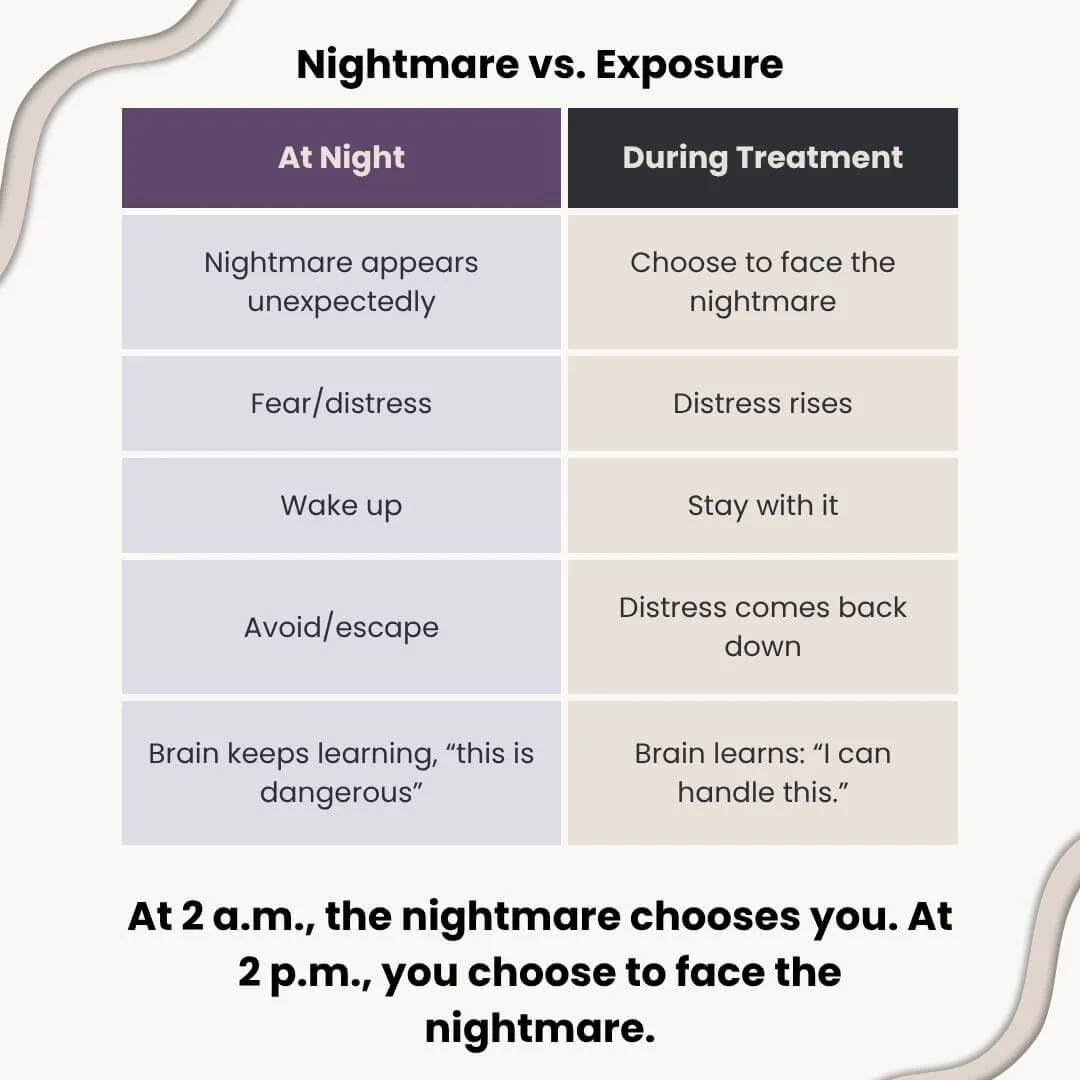
At 2 a.m., the nightmare chooses you. During exposure, you choose when to face it—and give your brain a chance to learn that you can handle the discomfort without escaping.
You’ve probably spent a considerable amount of time trying not to think about your nightmares. You might wonder why on earth you would deliberately bring it up during the day. Because avoidance reinforces the idea that the nightmare is dangerous and needs to be evaded.Exposure allows your brain to learn something different.
My husband and I got into the TV show Nip/Tuck. It aired on FX in the mid 2000s. The main characters were surgeons, so there were a lot of surprisingly graphic surgery scenes. At first, we both had to hide our eyes during those scenes. Over time, we adjusted, and by the end of the series we could watch them without recoiling. That's exposure.
We deliberately approach the nightmare rather than waiting for it to show up unexpectedly in the middle of the night. And yes, I expect you to get activated. A good exposure will cause some distress.
The goal isn’t to immediately make that discomfort disappear. It’s to give you an opportunity to experience the distress and discover that you can handle it. The anxiety rises. You stay with it. And eventually it comes back down without you having to do anything.
That experience teaches something that talking around the nightmare can't necessarily teach:
I can face this.
I don't have to escape.
The discomfort doesn't last forever.
I wrote more about this distinction in Why Talking About Your Nightmare Doesn’t Always Stop It.
Facing Your Nightmare During the Day Changes the Terms
There’s also a big difference between facing your nightmare at 2 a.m. and facing it at 2 p.m. At 2 a.m., you’re asleep. Your prefrontal cortex—the part of your brain involved in reasoning and decision-making—isn’t operating the same way it does when you’re awake.
You don’t choose the nightmare. It just shows up and slams you with something terrifying. Then you wake up with your heart pounding.
During treatment, you’re choosing to face it. You’re awake. Your thinking brain is online. You know what you’re doing and why you’re doing it. You’re approaching the nightmare on your terms instead of waiting for it to ambush you.
There’s something about that shift that takes some of the sting out of it.
Step 5: Giving Your Brain a Different Path to Take
After exposure comes another important part of treatment: rescripting. This is where we start deliberately giving your brain a different path to take.
Years ago, my husband was considering buying a Kia Soul. Remember those commercials with the hamsters? While he was contemplating this decision, we suddenly started seeing Kia Souls everywhere. I don’t think there was a sudden uptick in Kia Souls in Austin. We were just primed to notice them because we’d been thinking about them.
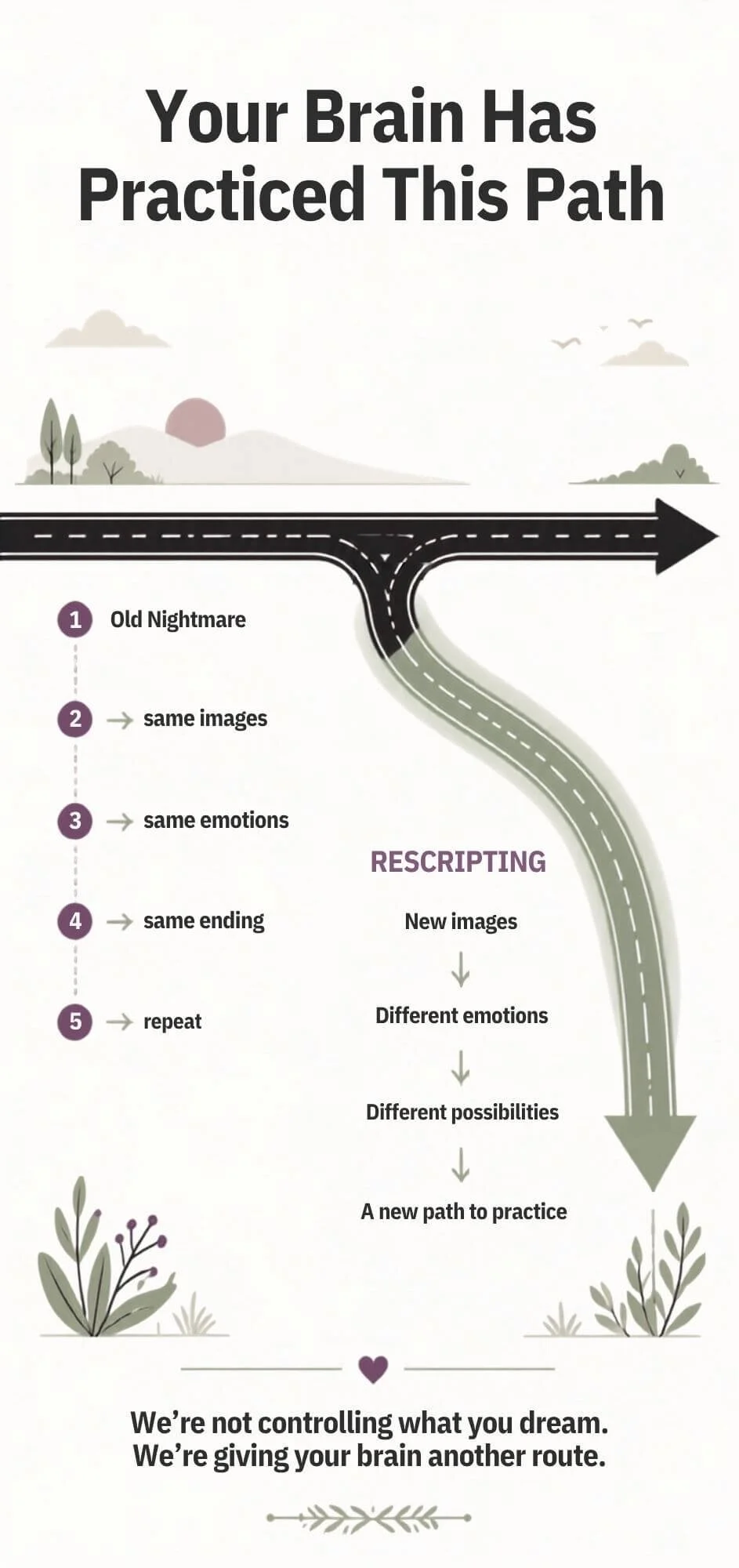
Nightmare rescripting doesn't require you to control what you dream. It gives your brain another path to practice instead of repeatedly traveling the same old one.
I think that’s a useful way to understand what we’re doing with nightmare rescripting. We’re priming your brain with different images and emotions so that the old nightmare isn’t the only path it has practiced. You create a new version of the dream and then deliberately visualize it.
Think about the way athletes use visualization. An athlete may mentally rehearse making the shot, running the play, or successfully performing a skill. They’re practicing with imagery. We’re also using imagery intentionally. Except instead of practicing your free throw, we’re giving your brain another possible route through a dream it has become very good at repeating.
Will I Actually Dream the New Dream?
Most likely not, but that’s okay. Here’s what often does happen: you stop having the old nightmare altogether, or it changes so much that it’s no longer distressing. We aren't trying to control exactly what your brain dreams tonight. We're giving it something different to practice.
Think of it as creating an exit ramp from a road your brain has traveled thousands of times. The old path exists. We're just making sure it isn't the only one available.
Step 6: Practice, Practice, Practice
In CBT-N, as in any form of CBT, you will have homework. CBT for Nightmares is highly structured, and there are things you’ll practice outside of our sessions. You’ll continue the relaxation practice and rehearse the new dream using imagery. Then, if there are other nightmares you’d like to target, we can use the same process with those.
This is an important distinction between behavioral treatment and simply talking about a problem once a week. I can teach you what to do in session. But your brain learns through repetition.
I once heard a CBT-I trainer—a literal expert in treating insomnia—tell a room full of therapists that he'd slept poorly the previous night. He knew exactly what he was supposed to do. He should have gotten out of bed. Did he? In his words: “Hell, no.” He was warm. He was comfortable. He didn't want to move.
I loved that story because it illustrates something we all know but sometimes forget: Knowing what to do and actually doing it are different things. You can understand nightmare treatment perfectly. Your brain still needs the practice.
What If I Have Insomnia Too?
This is pretty common. Having nightmares can change the way you approach sleep. Maybe you start delaying bedtime because you don't want to have another nightmare. Maybe you wake up from one and can't get back to sleep. Maybe you've spent so much time worrying about what will happen when you go to bed that your bed itself starts becoming associated with being awake and anxious.
Now we have nightmares and insomnia. That's why I assess everyone I treat for nightmares for insomnia as well.
If insomnia is part of the picture, I'll bring in tools from Cognitive Behavioral Therapy for Insomnia (CBT-I). Depending on what's happening, that might include stimulus control, sleep restriction, or cognitive strategies.
As I mentioned earlier, each sleep disorder has its own solution, so if we have co-occurring issues, we’ll address them all.
What If I Have More Than One Nightmare?
We can work on multiple nightmares. Once we've gone through exposure and rescripting with one nightmare, we can use the same process for other nightmares you'd like to target.
That's one of the things I like about behavioral treatment. I'm not just trying to make one nightmare disappear. I'm teaching you a process you can understand and use.
Toward the end of treatment, we'll also talk about how to stay on track and what to do if the problem ever starts creeping back in. Because the goal isn't for you to need me forever. The goal is for you to leave knowing what to do.
Does CBT for Nightmares Actually Work?
People come into nightmare treatment understandably skeptical. I often say, “You might be thinking there’s no way this could work.”
Then we do this relatively straightforward behavioral treatment, and people are surprised at the relief they get. I understand the hesitancy. It can’t be this simple, right? Well, nightmares are habits, and habits are always malleable.
But Simple Doesn't Mean Easy
CBT for Nightmares is relatively straightforward, but that doesn't make it easy. Facing something you've spent years trying not to think about takes courage. Exposure can be uncomfortable. Practicing between sessions requires effort. Changing your sleep habits can sometimes be difficult.
But treatment isn't mysterious. We're not spending years hunting for the secret insight that will finally unlock the meaning of your nightmare. We're just teaching your brain something different.
The brain learned something. The brain can learn something different.
What Happens When Treatment Ends?
CBT for Nightmares is typically about six sessions. Toward the end, we'll look at what's changed, what has been helpful, what you want to continue practicing, and what you'll do if the nightmares start creeping back in.
And I want to make an important distinction here: The goal of nightmare treatment isn't to guarantee that you'll never have another bad dream for the rest of your life. Humans have bad dreams sometimes.
The goal is for nightmares to stop being a chronic problem that disrupts your sleep, makes you dread bedtime, or affects how you function during the day. If you occasionally have a bizarre or unpleasant dream six months from now, treatment hasn't failed. You have tools. You’ll know what to do.
You Don't Have to Keep Dreading Bedtime
If you've lived with chronic nightmares for years, it's easy to start thinking of them as something you just have to live with. They're not.
CBT for Nightmares is a short, structured behavioral treatment designed to interrupt the patterns that keep nightmares going and give your brain something different to practice. You don't have to understand exactly why your nightmare started. You don't have to uncover some hidden meaning. And you don't have to spend years talking about it before you can start working toward relief.
If you'd like a broader overview of why chronic nightmares happen and why they're so treatable, you can read Nightmare Treatment: How to Stop Chronic Nightmares Without Years of Therapy.
For my thoughts on when nightmares warrant treatment, check out When Should You See a Therapist for Your Nightmares.
And if you're wondering whether treatment might be right for you, you can learn more about Nightmare Disorder Treatment in Austin.
You’ve practiced the old path long enough. We can teach your brain a new one.
About the Author
Jessica Fink, LCSW-S, is a therapist in private practice in Austin who specializes in sleep disorders. She has completed training and consultation in CBT for Nightmares and also has expertise in insomnia, hypersomnia, CPAP adherence, and circadian rhythm disorders.