Why Talking About Your Nightmare Doesn’t Always Stop It
There is value in talking about your nightmare. It can be healing to finally say out loud what’s been secretly swirling in your head. Sharing your experience can reduce shame, help you feel less alone, and give you a place to start making sense of what’s going on.
But if your goal is to actually stop having the nightmare, discussion alone isn’t going to cut it. You can dialogue something to death and see no improvement.
That’s because mere talking doesn’t interrupt the cycle that keeps a nightmare going. Your brain may comprehend the disturbing dream perfectly well and yet continue taking the same well-worn path every night. Understanding is useful, but it isn’t always sufficient for real change.
Talking About Your Nightmare Has Its Place
I don’t want to dismiss the usefulness of putting your nightmare into words. Our brains can come up with some absolutely bonkers storylines. Nightmares may contain difficult or even shameful subject matter. Saying it out loud to another person and feeling supported can be powerful.
Verbalizing can also help us understand what’s happening. Is this nightmare connected to trauma? Did it start after a medication change? Is another sleep disorder potentially involved? Those are useful questions. The problem comes when we assume that understanding the nightmare is equivalent to treating it. It’s not.
You can know exactly when and why your nightmare started. You can get to a place where you can talk about it without shame. And despite all of that, you can still keep having it.
Talking Can Be Avoidance, and Avoidance Is Sneaky
When I worked at Seton Shoal Creek in Austin, I ran a PTSD treatment group for a couple of years. One of the things I learned was to keep an eagle eye out for avoidance. People will try to mitigate their PTSD symptoms by taking all kinds of actions to avoid thoughts, feelings, or memories connected to the traumatic event. Sometimes that avoidance looked like a seemingly relevant story shared in session, and I would get pretty far into the narrative before realizing we weren’t getting anywhere productive.
People often aren’t even conscious that they’re avoiding, so I don’t fault anyone for telling a story. Also, that’s a lot like what we think therapy is supposed to look like, right? I’d eventually have to ask myself: Are we getting hotter or colder in relation to the actual problem? Is this helping or distracting?
This pattern shows up with nightmares too, even when the nightmares aren’t trauma-related. Nightmares are a horrifying experience unto themselves, so of course someone would keep reminders at bay during the day. And talking about it without purpose or direction can look deceptively like dealing with it.
What Does “Processing Your Trauma” Actually Mean?
I hear the phrase “processing trauma” a lot. It’s worth getting very specific about what that means. Processing trauma can mean completing an evidence-based treatment for PTSD and experiencing meaningful symptom relief. It can also mean talking about a traumatic experience over and over again without a clear treatment target or much improvement in symptoms. Those aren’t the same thing.
For some people, effective trauma treatment resolves their nightmares. For others, the other symptoms improve, but the nightmares stick around. That doesn’t necessarily mean there’s some deeper layer of trauma that hasn’t been uncovered yet. Sometimes the nightmare itself just needs to be targeted.
There are also people who don’t feel ready to plunge into trauma treatment. CBT for Nightmares can target the nightmares specifically, giving you some symptom relief without requiring you to tackle everything at once. Better sleep may even make eventually tackling the PTSD feel a little more manageable.
Talking and Exposure Aren’t Exactly Equivalent
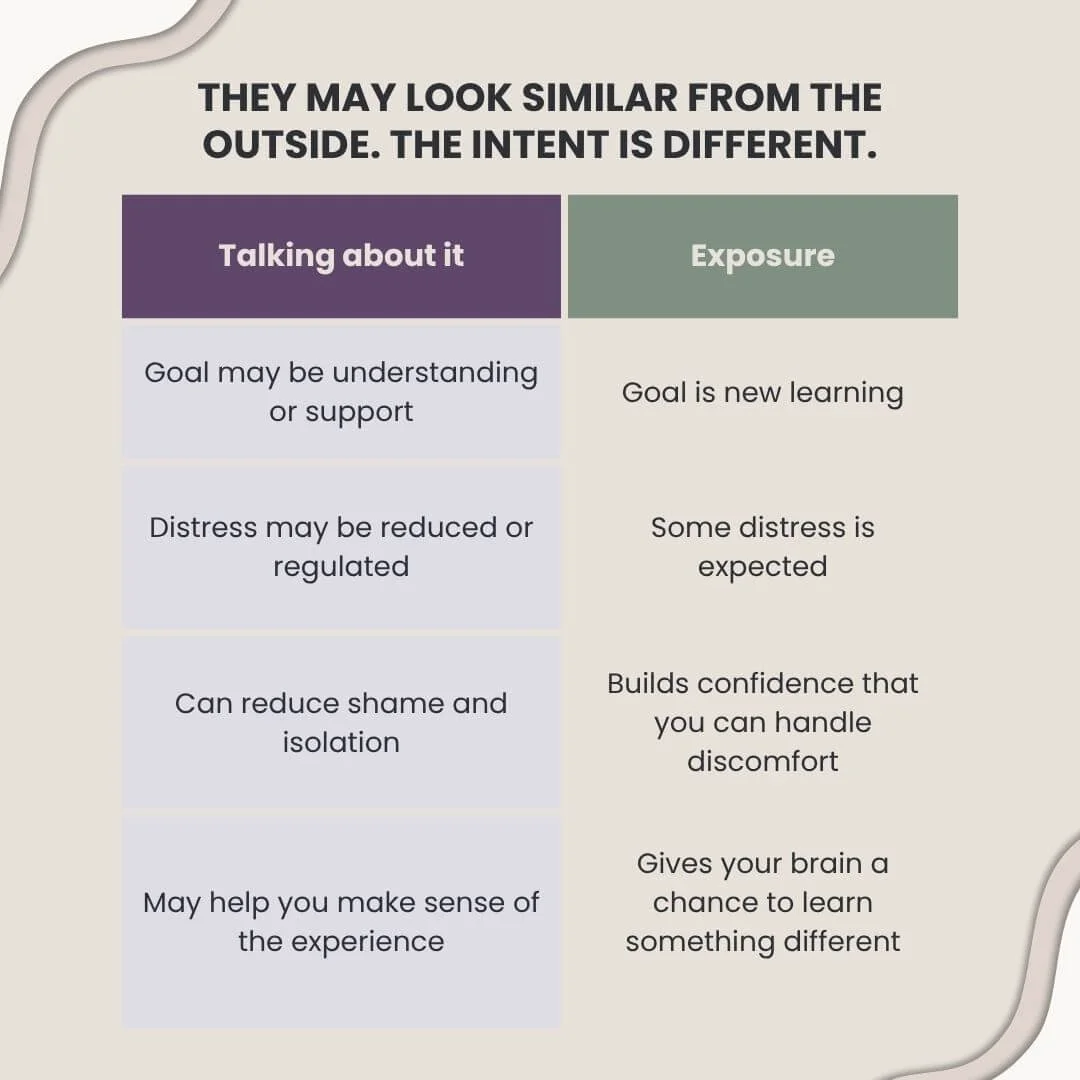
Talking about a nightmare and exposure can look similar from the outside, but the intent is different. Exposure deliberately creates an opportunity for your brain to learn that you can face the discomfort without escaping it.
This distinction is important because talking feels like it should work as exposure, and from the outside, the two look similar enough. The difference is that exposure is more structured and intentional. In an ordinary conversation, if you become really upset while talking about something, the natural therapist instinct is often to reassure you or help you regulate. We do something to bring the distress level down. Exposure works differently.
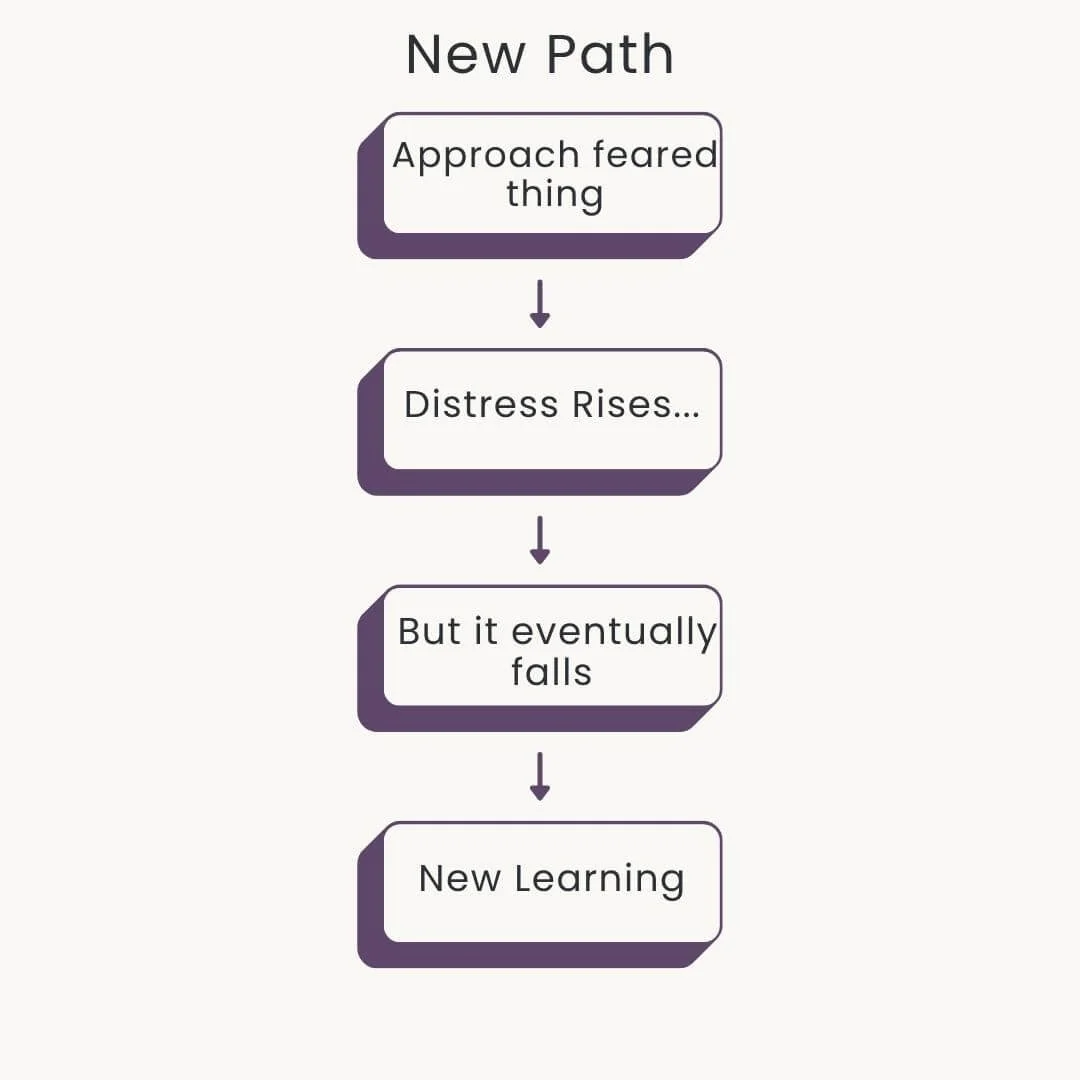
A good exposure will activate you.Bringing your arousal down prematurely cuts the legs off the exposure and ultimately keeps you in the same place of fear that is causing so many problems in the first place. When doing a therapeutic exposure, I expect your distress to go up. And rather than immediately doing something to assuage it, I allow it to come down on its own. I promise there is a good reason for this.
Exposure changes your relationship with fear and feared things. You discover that you are capable of facing it and that the discomfort doesn’t last forever. That’s very different from simply recounting what happened. Uncomfortable as it is, exposure creates an opportunity for lasting change. Exposure gets you to where the thing no longer scares you.
The Nightmare Looks Different at 2 A.M. vs. 2 P.M.
Normally, you don’t get to choose when you encounter your nightmare. You’re asleep. Your prefrontal cortex—the part of your brain involved in reasoning and decision-making—isn’t operating the same way it does when you’re awake. And suddenly you’re slammed with something terrifying. You wake up with your heart pounding.
Maybe you avoid going back to sleep because you’re afraid the nightmare will return. Maybe you spend the next day trying very hard not to think about it. Then nighttime comes around again, and you know what’s going to happen.
Nightmare treatment changes the terms. Instead of waiting for the nightmare to ambush you in the middle of the night, we deliberately face it during the day. You’re awake. Your thinking brain is online. You are in control. You’re approaching the nightmare on your terms instead of waiting for it to come after you. There’s something about that shift that takes some of the sting out of it.
Why Avoidance Keeps the Cycle Going
Humans naturally avoid things that scare us. If thinking about something makes you anxious, not thinking about it will provide relief. And relief feels good. The problem is what your brain learns from that relief. It reinforces the idea that the nightmare is, in fact, dangerous and should continue to be avoided.
This can set up a miserable cycle of avoiding sleep at night and then being a complete zombie during the day because you aren’t getting enough sleep. Maybe you also spend your day trying really hard not to think about it, which is quite taxing on the energy you have. Imagine trying to keep a beach ball under the surface of the water in a pool. How long could you sustain it? How fatigued would your arms get? Are you even enjoying the pool at all, given that all of your energy is going toward keeping this beach ball submerged?
Avoidance works beautifully in the short term. That’s why we do it. But it comes at a cost. So long as your brain is convinced the nightmare is dangerous, you are at its mercy. You know that scene in The Matrix where Keanu Reeves is being shot at, and then suddenly the bullets can’t hurt him anymore because he’s seeing it all for what it really is? That’s how exposure works.
Talking About the Nightmare Isn’t the End Goal. We’ve Got to Interrupt the Cycle.
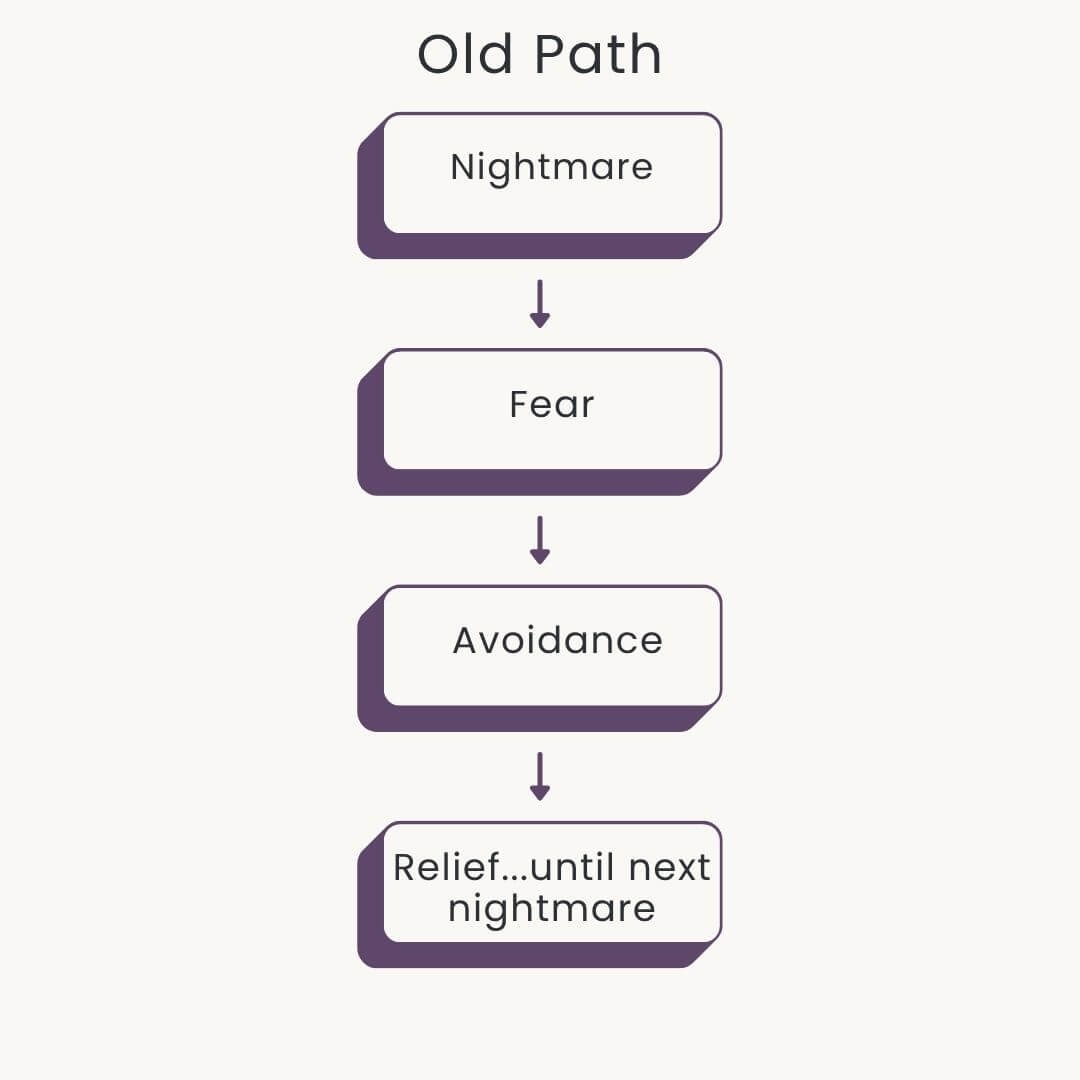
Avoidance provides relief in the short term, but it can reinforce the old nightmare pathway. Behavioral treatment gives your brain an opportunity to practice something different.
This is where behavioral nightmare treatment differs from simply discussing what happened. We’re not talking about the nightmare just to talk about it. We’re doing something with it. The full course of nightmare treatment includes relaxation strategies, exposure, rescripting the nightmare, visualizing the new dream, and addressing insomnia or other sleep issues that have developed alongside the nightmares.
All of this is directed toward one goal: Give your brain a different path to take.If your brain has practiced the same nightmare hundreds or thousands of times, it has become very good at going down that path. Treatment gives it something new to practice. That’s why I conceptualize chronic nightmares as a learned behavior. And it’s also why I’m so optimistic about treating them.
The brain learned something. The brain can learn something different.
You Don’t Need Years of Therapy Just Because You’ve Had Years of Nightmares
This is one of the misconceptions about nightmare treatment I most want to change. Someone will tell me they’ve had the same nightmare for 10, 15, or 20 years, and underneath that statement is often a fear that they’re unhelpable or that treatment will take years. It makes intuitive sense. Big, longstanding problem = big, long solution, right? Fortunately, that’s not actually the deal here. CBT for Nightmares is approximately six sessions.
We don’t need to plumb the depths of your unconscious to get you off this awful ride. We target the processes that are keeping it going now and help your brain learn something different. The age of the nightmare tells me how long you’ve been experiencing it. It predicts nothing about how long it will take to fix it.
Talking Can Be Part of Treatment. But It Isn’t the Whole Treatment.
You don’t have to choose between understanding what’s going on and making the nightmares stop. You can have both. We can talk about it, explore it, and reduce the shame. And then we can get in there and fix it.
If you’d like to understand more about why nightmares become chronic and how behavioral treatment can interrupt the cycle, read Nightmare Treatment: Why You Don’t Have to Live With Chronic Nightmares.
If you’d like to know more about the relationship between nightmares and trauma, you may also find Are Nightmares a Sign of Trauma? Not Always. helpful.
And if you’ve had the same nightmare for years, I’ve written more about why recurring nightmares become learned patterns—and why those patterns can change.
You Can Give Your Brain a Different Path
Talking about your nightmare may help you understand it. It may help you feel less ashamed of it. It may help you realize you’re not alone. Those things matter.
But if you’ve talked about your nightmare again and again and you’re frustrated that it keeps showing up anyway, that doesn’t mean you’re doing something wrong. We’ve got to give your brain a new path.
If recurring nightmares are disrupting your sleep or making you dread bedtime, I offer evidence-based behavioral treatment specifically for nightmare disorder. You don’t have to spend years talking about your nightmares before you’re allowed to start getting relief.
About the Author
Jessica Fink, LCSW-S, is a therapist in Austin with 19 years of experience in mental health. She has completed specialized training and consultation in CBT for nightmares, and her practice focuses on sleep disorders. She trains and offers consultation on sleep disorders to other therapists.