Why Do I Keep Having the Same Nightmare?
If you've been having the same nightmare for years, you've probably wondered why it keeps happening. Further, you’ve likely worried that this awful dream is just here to stay.
I've had many clients express versions of those concerns. By the time they come to see me, they've often spent years dreading bedtime and wondering whether recurring nightmares are just something they have to live with now.
I have good news. Having the same nightmare over and over doesn't mean you're broken. It doesn't necessarily mean your trauma isn't resolved. And it doesn't mean you'll be stuck having that nightmare forever.
One of the biggest misconceptions I see is the belief that if a nightmare has been happening for years, it must require years of therapy to fix. That makes logical sense, but treating nightmares happens on a much shorter timeline than you might expect.
My perspective, both as a therapist and someone who specializes in treating sleep disorders, is actually much simpler: The brain learned something. The brain can learn something different. The same ability that allowed your brain to learn the nightmare is the ability that allows treatment to work. That idea explains far more about recurring nightmares than most people realize.
Why Your Brain Keeps Taking the Same Path
When I was in eighth grade, one of my friends had a huge crush on a boy. Being thirteen, simply telling him she liked him was obviously out of the question. Instead, she came up with what made perfect sense to a middle-school brain. He was a huge Will Smith fan. The song Gettin' Jiggy Wit It had just come out. She decided that if she learned every word to the song, somehow he'd like her. I had just bought the CD, so I brought it over to her house, and we listened to that song over and over and over. I honestly don't remember whether she ever ended up dating him. But more than twenty-five years later...I can still rattle off significant chunks of that song.
That's how brains work. They learn through repetition. Usually that's a wonderful thing. It's how we learn to read, ride a bike, type without looking at the keyboard, or drive home without consciously thinking about every turn. But our brains don't only learn helpful habits. They also become very good at repeating patterns we'd rather not have.
Recurring nightmares are one example. The brain isn't choosing to replay the same nightmare because it thinks you deserve to suffer. It's doing what brains do: repeating pathways that have become well practiced. The fact that your brain has become good at producing the same nightmare doesn't mean the nightmare is permanent. It means your brain has practiced that pathway many, many times.
And practiced pathways can change.
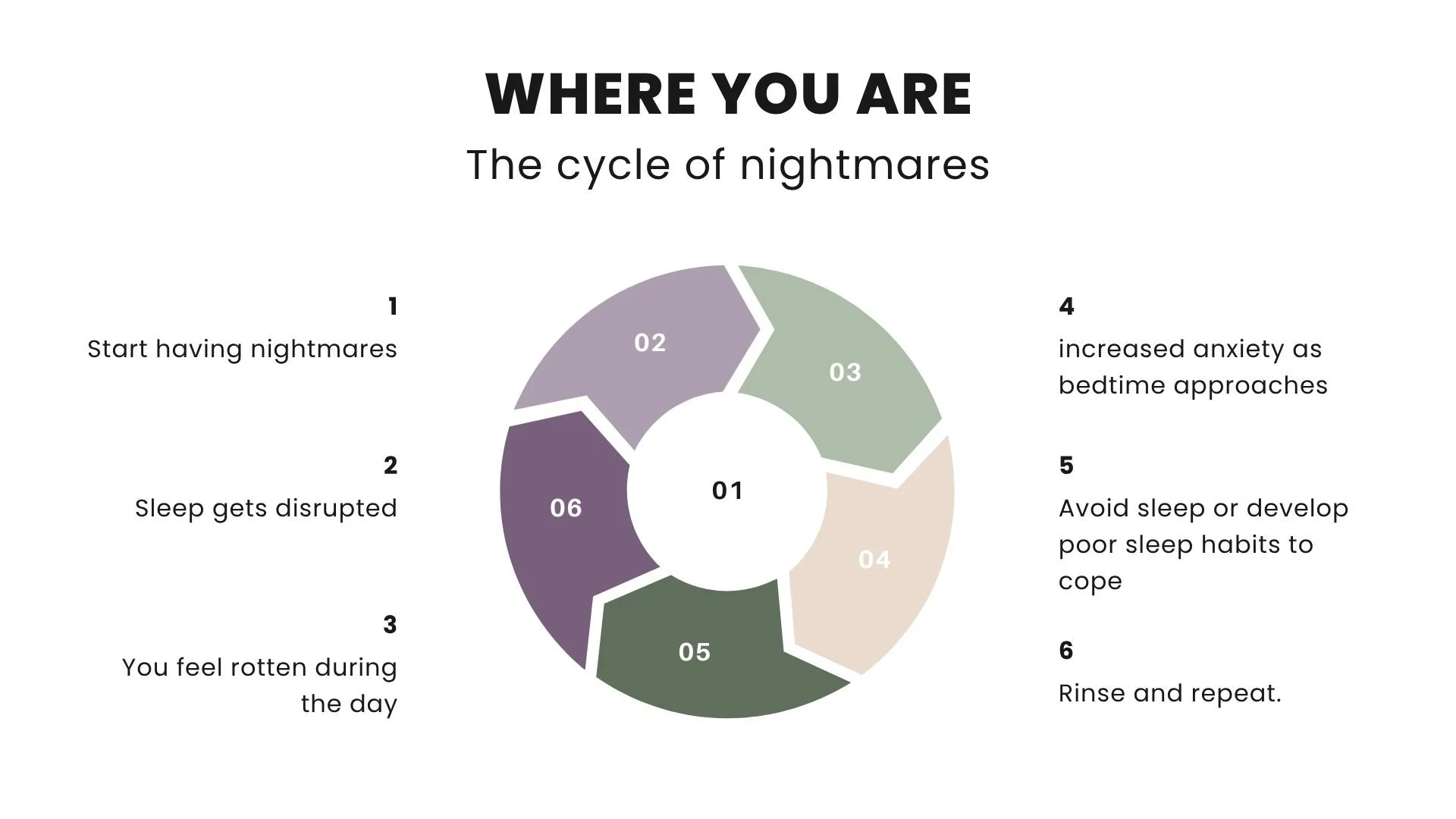
Nightmares often become self-perpetuating. Treatment focuses on interrupting this cycle rather than simply waiting for the nightmares to stop.
Why Do Nightmares Start?
Before we talk about why nightmares keep repeating, it's helpful to separate two different questions.
Why did the nightmare start?
and
Why is it still happening?
Because the answers are often not the same.
We still don't know exactly why we dream, but there are two leading theories for why nightmares occur.
Theory #1: Your Brain Is Trying to Process Something
One theory is that nightmares are part of the brain's attempt to process emotionally significant events, especially trauma. The idea is that the brain is trying to make sense of what happened, but the process gets interrupted because the nightmare wakes you up before it can resolve. I sometimes think of it like a record skipping. Instead of reaching the end of the song, it keeps jumping back to the same spot.
Theory #2: Your Dreams Reflect Your Emotional State
Another theory is that our dreams tend to match our emotional state when we go to bed. It's like how we tend to want to listen to upbeat music when we're happy, mopey music when we're sad, and screamy music when we're angry. If you're stressed, anxious, overwhelmed, or fearful, your dreams may be more likely to take on those same emotional qualities.
I've also heard it described this way: the brain makes a soup with whatever ingredients it has available—memories, worries, emotions, random experiences, and sometimes things that make absolutely no sense. We’ve all had dreams featuring people in our lives who have never met one another or non-sequiturs like a dog driving a car.
Both theories have merit. Some people resonate more with one and some more with the other. But I don't think either one fully explains why someone continues having the exact same nightmare for ten or twenty years. That's a different issue.
For that, I think we have to look at how the brain learns.
For a deeper exploration of the meaning of nightmares, check out my blog What Do Nightmares Mean? Probably Less Than You Think.
Why the Same Nightmare Can Continue for Years
The brain is designed to become efficient. When it finds a pathway that gets used repeatedly, it tends to strengthen that pathway. Most of the time that's incredibly helpful. It's why you don't have to relearn how to drive every morning. It's why you can tie your shoes without thinking about every step.
And I think recurring nightmares work in much the same way. Over time, the brain becomes very efficient at producing the same imagery, the same storyline, and the same emotional response. The nightmare becomes a habit.
That doesn't mean the nightmare is serving an important purpose today. It doesn't even necessarily mean the original trigger is still active. It simply means your brain has become very good at taking the same path.
Does Having the Same Nightmare Mean My Trauma Isn't Resolved?
Maybe, but not necessarily. Nightmares frequently follow trauma, and for a lot of people, addressing the trauma also addresses the nightmares. But some people complete trauma treatment and find that the nightmares are the one thing that sticks.
Think about it this way. If someone develops insomnia during a stressful divorce, we wouldn't assume that continuing insomnia ten years later means the divorce is still emotionally unresolved. The insomnia may have started because of the divorce. But what keeps it going years later is often a completely different set of learned behaviors.
I think nightmares can work the same way.
It's also important to remember that trauma isn't the only cause of recurring nightmares. It frequently is, but not always. Some people develop nightmare disorder without any clear precipitating event. Nightmares can also occur as a side effect of certain medications—including medications prescribed for completely unrelated conditions—alongside sleep disorders like narcolepsy, or in people with untreated obstructive sleep apnea.
That's one reason I think a thorough assessment is so important. If we assume every nightmare is a sign of unresolved trauma, we risk overlooking other explanations that may be much more accurate—and much more treatable.
If you've ever worried that recurring nightmares automatically mean you have unresolved trauma, I wrote a separate article explaining why trauma is only one of several possible causes—and why we don't have to determine the exact cause before we can effectively treat the nightmares.
Why Avoiding the Nightmare Usually Backfires
When people are terrified of their nightmares, they naturally start trying not to think about them. That makes sense. Who would voluntarily think about something that scares them? Not thinking about it gives you relief, and we all want relief.
The problem is that avoiding the nightmare often teaches the brain that the nightmare is dangerous. The more dangerous something feels, the more attention the brain gives it. Avoidance might provide temporary relief, but it doesn't help the brain learn that the nightmare no longer requires an alarm response.
This is one reason treatments for nightmare disorder often include carefully and intentionally facing the nightmare during the day. Instead of being ambushed at two o'clock in the morning, you're choosing when and how to engage with it. You're doing it while your thinking brain is fully online.
You're in control. That shift matters.
The Good News: Learned Patterns Can Change
One of the most hopeful things about recurring nightmares is that they're learned patterns. And learned patterns are changeable.
The goal of treatment isn't to erase your memory. It's to help your brain stop automatically taking the same well-worn path every night.
That's why treatments like imagery rehearsal, exposure, and other behavioral interventions can be so effective. They aren't magic. They're helping your brain learn something new.
If you'd like to learn more about how nightmare treatment works, I go into much more detail in my article, Nightmare Treatment: Why You Don't Have to Live With Chronic Nightmares.
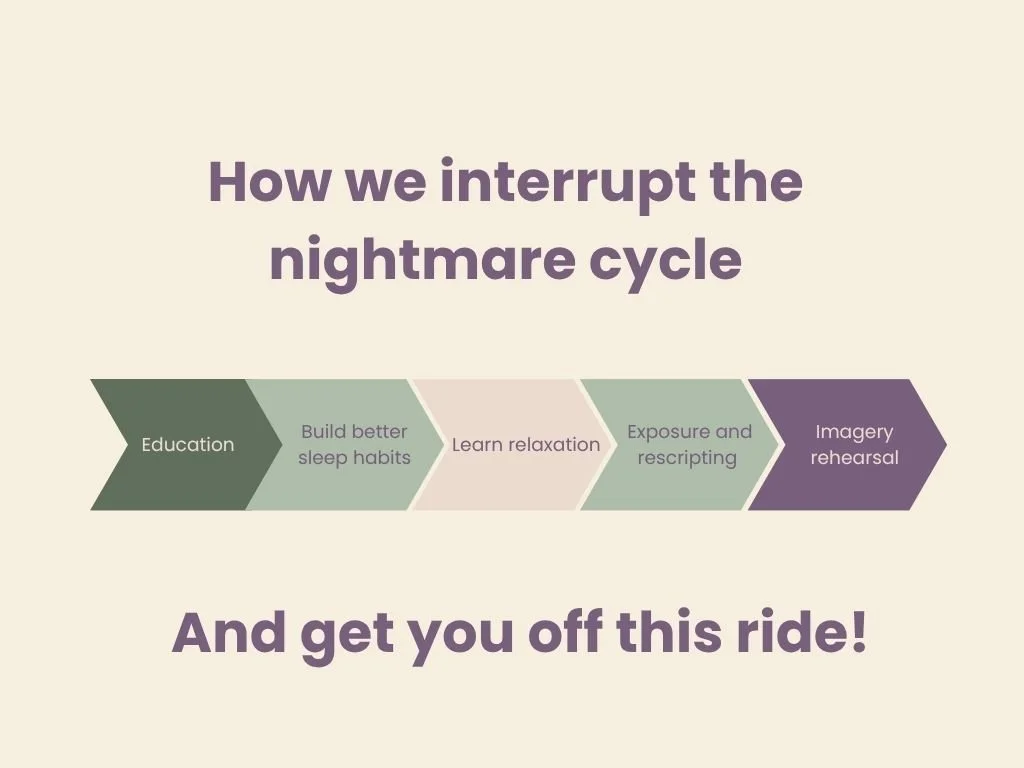
Nightmare treatment isn't about analyzing dreams. It's about helping your brain learn a different path.
You Are Not Permanently Stuck
If you've been having the same nightmare for years—or even decades—it makes sense that you've started wondering whether this is simply who you are now.
It isn't. The age of a habit tells us how practiced it is, not how permanent it is. Your brain learned one pathway. With the right treatment, it can learn another.
Ready to stop having the same nightmare?
Nightmare disorder is highly treatable, and many people experience significant improvement in just a few weeks.
Ready to Stop Dreading Bedtime?
I'm Jessica Fink, LCSW-S, a therapist of 19 years specializing in behavioral sleep medicine. I help adults overcome nightmare disorder and insomnia using evidence-based behavioral treatments that target the patterns keeping sleep problems going. I have specialized training plus extra consultation in Cognitive Behavioral Therapy for Nightmares. If recurring nightmares have taken over your nights, I'd love to help you get your sleep—and your life—back.